The Threads of the Atlas
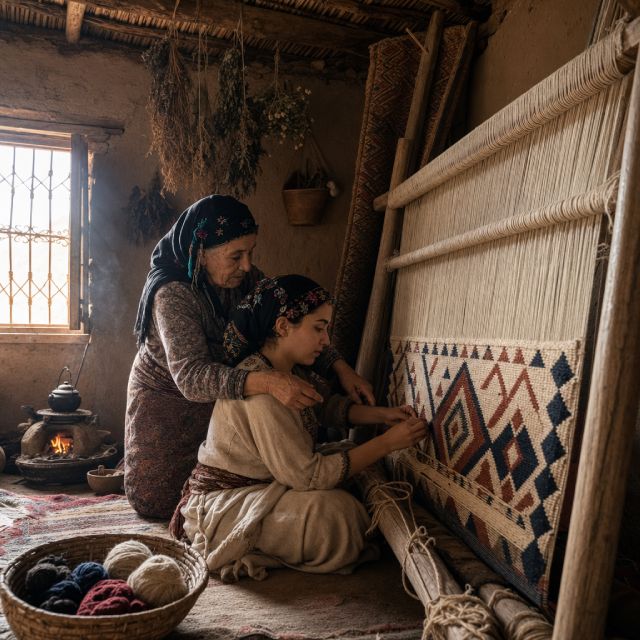
The winter wind came down from the snowy peaks, whistling between the stone and wooden houses. In Tifrit, in the High Atlas, the air smelled of burnt cedar, damp wool, and dried herbs hanging under the eaves. Tiziri, nineteen years old, sat in front of the loom placed at the back of the room. Her fingers, already calloused from months of practice, hesitated above the threads of undyed wool, indigo, and madder red.
"Do not tighten the knot too much," whispered Tamghart as she approached. "The wool listens before it responds."
The old woman sat beside her. Her hands, gnarled like olive roots, took up the thread with measured slowness. Each pass of the shuttle produced a sharp, regular snap, like the beating of an ancient heart.
"The pattern you are trying to recreate," Tamghart continued, "is not decoration. It is a path."
Tiziri looked up. Her grandmother pointed to a series of interlocking triangles, interrupted by zigzags and hollow diamonds. "The triangles are the mountains our ancestors crossed when the pastures dried up. The zigzags are the wadis that change course after the rains. The diamonds are the villages abandoned, then found again, then left once more. When a woman weaves, she does not just cover the ground. She traces memory."
In the Berber culture of the High Atlas, the rug is never a silent object. It is an archive, a map, a prayer. Women record the seasons, births, losses, and alliances. The patterns, passed down from mother to daughter, vary by valley but carry the same philosophy: the world is a network of paths, and every step leaves a mark.
"Why is it so difficult?" asked Tiziri. "I see the shapes, I count the threads, but something escapes me."
Tamghart smiled. "Because you weave with your eyes. You must weave with your breath. Listen."
She closed her eyelids. Her fingers now moved without looking. The loom breathed with her. "When your great-grandmother first wove this pattern, the men had gone to the plains to sell salt. She stayed alone with the children and livestock. One evening, a she-wolf prowled around the village. Instead of panicking, she lit a fire, sang, and continued weaving. The she-wolf sat a few steps away, listened, then left. The next day, tracks were found leading north. They indicated a hidden spring. The rug kept that night. That is why there is a void in the center: the she-wolf, the silence, the waiting."
Tiziri breathed slowly. She stopped counting. She let her hands follow the rhythm of the snaps, the taut thread, the wool that yields then holds firm. Gradually, the shapes emerged, not as an imposed design but as a conversation.
Days passed. The village was busy preparing for Yennayer, the Amazigh New Year. Courtyards were cleaned, couscous with seven vegetables was prepared, protective symbols were carved on doorsteps. Children sang ancient chants to call for rain and fertility. Tiziri remained before the loom. The rug grew, heavy with meaning, silent and persistent.
The day before the festival, Tamghart did not come. She had lain down on her bed, eyes closed, hands resting on her belly. Tiziri understood. She finished the last row herself, cut the threads, and beat the loom with a wooden comb to flatten the weave. When she unrolled the rug in the middle of the room, the women breathed out collectively. The colors vibrated. The patterns spoke.
On the evening of Yennayer, the village gathered around the fire. The rug was placed in the center as one would place a stele or an open book. The imedyazen, the traveling poet, struck his bendir three times. "What the ancestors walked, our hands hold. What the mountains kept, our threads retell."
Tiziri sat beside the weaving. She did not yet know what life would ask her to weave. But she now knew that every knot was a promise, every color a memory, every space a place where the future could breathe.



