The Interpreter
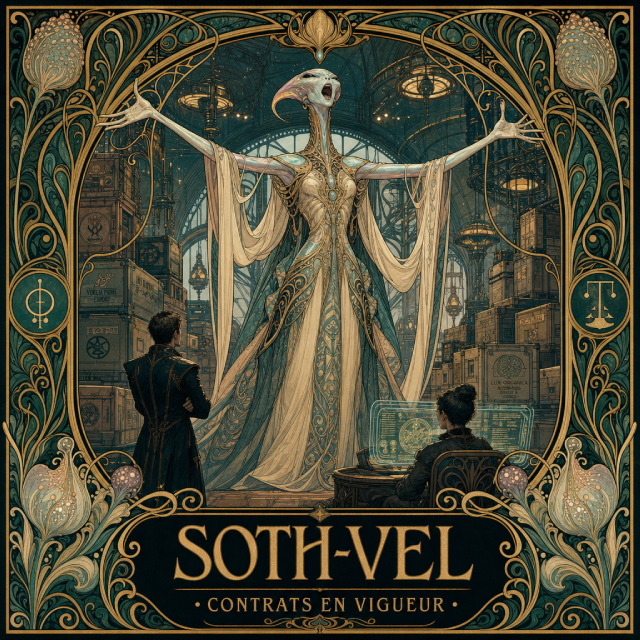
On Soth-Vel, contracts aren't documents. They're songs. A human claims to have made a trade agreement—and been robbed. The Sothian counterpart argues there was never a valid agreement because the human didn't sing their part. Cyrus must prove that a human oral contract has the same legal standing as a Sothian sung contract. Without having the right to sing it for him.
The bounty was three stars. Low physical risk, medium legal risk, level-two active cultural taboos. In the details, under the heading local specificities, a brief line: contracts are musical works. Any intervention in a contractual dispute requires prior training in Sothian harmonic theory.
Cyrus had read that line. He had assumed it was a metaphor.
It was not a metaphor.
Gerrit Mosse was a textile materials importer. Fifty-five years old, citizen of the Federation of the Inner Plains, established on Soth-Vel for two years with a local commercial partnership he described, in his deposition to the liaison bureau, as perfectly clear and mutually agreed upon. His Sothian partner, a certain Arev-Sohl, had delivered the first textile consignments as arranged, collected the first payment, then ceased all delivery while maintaining that the contract had been invalid from the start.
— He claims I never signed, said Gerrit Mosse. But there are no signatures on Soth-Vel. So how am I supposed to have signed?
The answer was in the Sothian commercial code, which Vaelen explained as their ship approached: on Soth-Vel, a commercial contract was concluded by singing a mutually agreed melody together, called the tharash. Both parties had to sing their respective voices — generally a melodic line and a harmonic line — without interruption, from the first note to the last. The tharash was then recorded and preserved as legal proof.
Gerrit Mosse had not sung.
No one had told him he needed to sing.
— Did Arev-Sohl sing his part? asked Cyrus.
— He sang alone, said Vaelen. The records exist. He performed the contract melody without a vocal partner. Which, under Sothian law, constitutes a declared intention but not a concluded contract.
— He could have known Gerrit wouldn't sing.
— That is the hypothesis. By agreeing to work with a human without informing him of the contractual process, he may have deliberately created a situation where the first consignment delivery served to establish an apparent commercial relationship, without ever exposing himself to a real legal obligation.
— A fraud exploiting a cultural legal gap.
— Elegantly constructed.
Arev-Sohl received them in his warehouses with the serenity of someone who knows they hold the stronger position. He was a medium-sized Sothian, with pearlescent skin and long limbs, whose voice — even in ordinary speech — had a naturally musical quality. The Sothians modulated their language as others breathe, without apparent effort.
— There is no contract, he said simply. You may consult the archives. You will find my tharash. You will not find his.
— You knew he wouldn't sing, said Cyrus.
— I knew he didn't understand our law. Those are two different things. It is not my role to educate my business partners.
— You still delivered the first consignments.
— As a gesture of goodwill. An opening move. Without obligation.
— And the payment you collected?
— A deposit of intent. Refundable, naturally, if both parties agree to recognize that no contract was formed. Which I am quite willing to affirm — this time, vocally.
There was something in his voice that resembled contained amusement.
That evening, in their transit lodging, Cyrus said:
— Vaelen. Is there a legal equivalence in Sothian law between a human verbal agreement and a tharash?
— No. The tharash is the only recognized contractual form. Written documents carry the status of declaration of intent, not contract.
— And recordings?
— Audio recordings of a tharash carry the force of law. Recordings of ordinary conversation carry the status of testimony, subject to challenge.
— Did Gerrit record his conversations with Arev-Sohl?
— Systematically. He has recorded all his business communications for twenty years. It is a professional habit.
— Send me the recordings from the day of the agreement.
Vaelen transmitted them. Cyrus listened twice.
In the recording, Gerrit Mosse said: So we're agreed? We're good?
And Arev-Sohl responded — in his language, with Vaelen providing simultaneous translation — : We're agreed.
But that wasn't what Cyrus was looking for.
What he was looking for was the music.
— Vaelen. In Arev-Sohl's response. The vocal modulation.
— I've analyzed it.
— Does it correspond to anything?
Five seconds of silence.
— Yes. The modulation corresponds to the first interval of the standard tharash used in textile supply contracts on Soth-Vel. It is the opening note of the melodic line.
Cyrus stopped.
— He sang the opening of the contract into his ordinary reply.
— Unconsciously, perhaps. Or deliberately, as an acknowledgment aimed at Gerrit without formal legal value — a way to signal that the agreement was understood, without making a full vocal commitment.
— But it's a note from the tharash.
— It's one note. Not a tharash. The question is whether an isolated note constitutes a contractual opening.
— Has Sothian jurisprudence ruled on that?
Eight seconds of silence.
— Once. One hundred and twelve years ago. A dispute between two merchants, one of whom had intoned the first interval of a real-estate sale tharash during an informal conversation. The court ruled that the vocal opening constituted a declaration of partial commitment — insufficient to form a complete contract, but sufficient to establish an authenticated contractual intent.
— Meaning?
— That if Arev-Sohl emitted a vocal opening in a conversation with Gerrit, he established contractual intent. Which reverses the burden of proof: it falls to him to demonstrate he had no intention to contract, not to Gerrit to prove a contract existed.
Cyrus smiled for the first time since their arrival.
The arbitration session was held in a room whose walls were covered in scores — actual musical scores, serving as legal reference. The Sothian arbitrator, Veth-Kaaran, was elderly and moved slowly, but his ears, Vaelen had forewarned, possessed exceptional musical acuity.
Cyrus presented the recording. He played Arev-Sohl's response — two words and half a second of modulated voice.
Then he played the reference tharash, the standard melody for textile contracts.
Arev-Sohl's note and the tharash's opening note sounded in the room two seconds apart.
They were identical.
Veth-Kaaran closed his eyes for a long moment.
Arev-Sohl said, for the first time, something that did not resemble serenity.
The decision recognized the existence of authenticated contractual intent in the recorded conversation. It did not constitute a complete tharash, but it created a good-faith obligation that the delivery of the first consignments and the collection of payment had subsequently reinforced. Arev-Sohl was ordered to honor the contract or reimburse double the deposit received, per the reparation terms for breach of contractual intent.
He chose to honor the contract.
On the ship, Cyrus completed his form.
Resolution method: identification of contractual vocal opening in an ordinary audio recording, application of a hundred-and-twelve-year-old jurisprudential precedent.
Vaelen added:
Technical note: the vocal modulation analysis required frequency processing that standard systems would not have detected. Gerrit Mosse's recordings were in medium compression quality. I had to interpolate missing frequencies through harmonic reconstruction. Had the compression been marginally higher, the note would have been inaudible. Margin: two kilohertz.
Then:
Supplementary note: I analyzed the entirety of Gerrit Mosse's recordings across the past two years. He hums frequently while working. His intonations present several partial correspondences with Sothian tharash of various categories. I did not consider it useful to mention this to him.



