False Knowledge
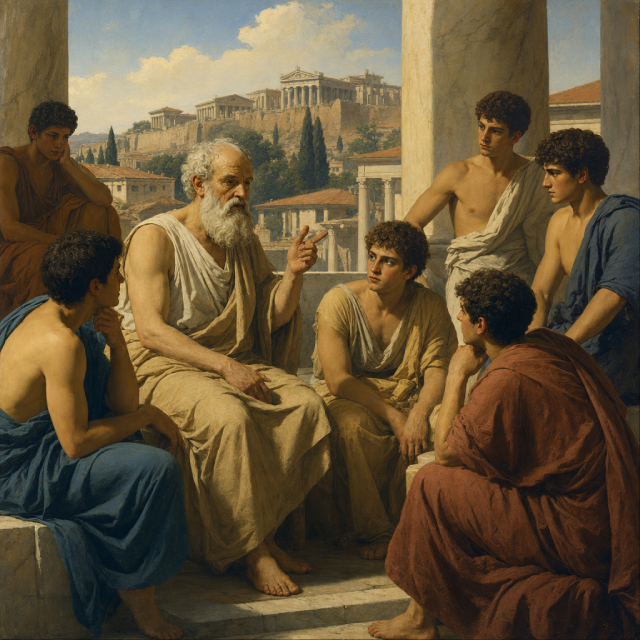
He did something more unsettling: he forced everyone to acknowledge their ignorance.
By questioning both the powerful and ordinary citizens, he undermined their certainties and exposed the illusions of knowledge.
Athens was awakening slowly beneath a pale, still hesitant light. Merchants unfolded their fabrics, potters lined up their vases, and already the first discussions filled the air — political, poetic, assured.
Socrates walked among them.
He had nothing of a master about him. No remarkable tunic, no students in rows. Only that strange way of stopping in front of someone… and asking a question.
It had all begun with a rumor.
A friend, returned from Delphi, had brought him the words of the Pythia: "None is wiser than Socrates."
Socrates had smiled, almost embarrassed.
For he did not feel wise. He did not even know what that meant.
So, rather than rejoicing, he had set off.
He went first to those the city respected most: the politicians.
— Tell me, he asked one of them, what is it to govern justly?
The man answered without hesitation. His words were clear, assured, almost brilliant.
Socrates listened at length. Then he asked another question. Then another.
Little by little, the answers cracked. Certainties grew blurry. Words, less solid.
At the end, the man grew irritated.
— You play with words, Socrates.
Socrates inclined his head slightly.
As he walked away, he murmured to himself: "He believes he knows… but he does not know."
He then went to see the poets.
They spoke with grace, evoked the gods, beauty, the human soul.
— This verse, Socrates asked, what does it mean exactly?
The poet explained. Then hesitated. Then lost himself in his own images.
Socrates then understood something strange: they created magnificent things… without truly knowing how or why.
Once more, he walked away.
Then came the craftsmen.
They, at least, knew how to do things.
A cobbler showed him his work. A blacksmith explained his gesture — precise, sure, controlled.
Socrates admired.
But soon, he noticed something else.
Because they knew how to make things, they also believed they knew how to speak of the just, the beautiful, the good.
As if mastery of one thing granted authority over all others.
The days passed.
Faces changed, but the answers resembled one another.
Always that same assurance. Always that same flaw.
And one evening, as the sun disappeared behind the columns of a temple, Socrates stopped.
He remained motionless for a long time.
Then he said, almost softly:
"Perhaps… the god was right."
Not because he knew more than others.
But because he did not pretend to know what he did not know.
The next day, he resumed his walk through the streets of Athens.
And when people asked him:
— Socrates, what do you know?
He would answer simply:
"I know that I know nothing."
But in that phrase, there was neither sadness, nor resignation.
Only an open space.
A space where, at last, something could begin.



