The Offering of Salt
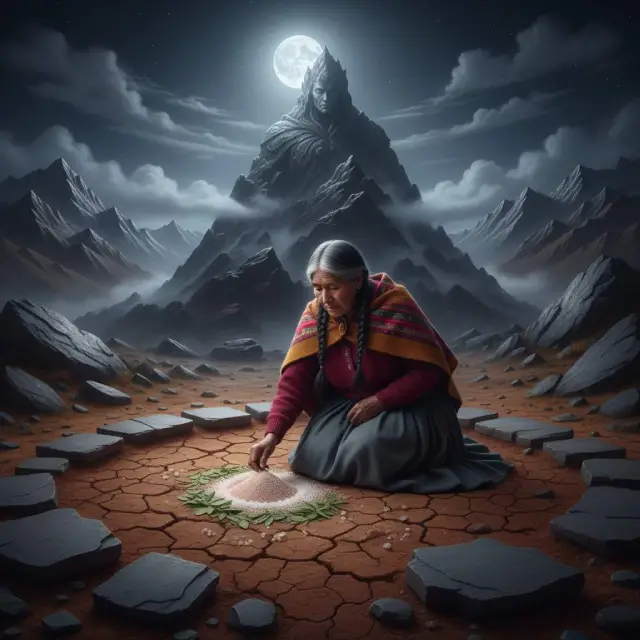
The wind whistles through the dry-stone walls of Waruqa. The thatched roofs bend slightly, as if in prayer. No one ventures out after sunset—not since Mateo betrayed the community.
He sold the sacred water of the Inti Punku spring to foreigners who arrived in 4x4s, with legal papers and smiles full of promise. The water has been diverted. The wells are drying up. The children cough.
And Mateo sleeps peacefully behind locked doors, counting his money under the light of a yellow bulb.
In a room where the walls are draped in indigo-dyed fabric, Mama Killa grinds pink salt with a smooth stone. Her fingers are gnarled, her eyes barely blink.
She is not the oldest in the village—but she is the guardian of the offerings. The one who knows how to speak to the earth without shouting. On the rough wooden table:
- Three fresh coca leaves.
- A handful of quinoa grains.
- A vial of the water that is no longer meant to be drunk.
- And the salt—harvested from the slopes of the Salar, where Pachamama sleeps in silence.
Midnight. The moon is veiled.
Mama Killa descends toward the dried-up spring. Her steps make no sound. She draws a circle with the ash, then places the offering in the center.
But this is not a prayer of gratitude. It is a **request for reparation**.
She intones an ancient chant in Quechua, without looking up. The wind changes direction. The air becomes heavy, like a spilling liquid.
“Pachamama, qan rikurqanki. Qan yachanki.
Chayqari qanmanta suqha qanqa ima sayk’ayta mana rikunkachu.
Chay qollqayki, yaku taqanqa,
asnu asnuña musq’ayku.”
(Pachamama, you have seen. You know.
That the one who stole from you will taste nothing more.
That his hands, which sold the water,
will burn endlessly.)
She pours the vial—not onto the earth, but onto the salt. The water disappears, absorbed as if by an invisible mouth.
Mateo wakes up with his throat on fire.
He drinks a glass of water. Then two. Then the whole pitcher. Nothing soothes it. He runs to the well, splashes water on his face, and gulps it down like an animal. But his skin cracks. His lips are bleeding.
The villagers watch him from their doorways, motionless. No one speaks to him.
That evening, he screams that he's been poisoned. He accuses everyone. Then he falls to his knees, his hands buried in the dry dust, licking the earth like a dog.
Three days later, they find him at the edge of the dried-up spring.
He lies on his back, eyes open, mouth full of salt.
Around him, no footprints—except his own, in a circle, as if he had been circling endlessly.
Mama Killa says nothing. She simply goes to the market, buys three more bags of salt, and returns home.
But as she passes Mateo's empty house, she places a coca leaf on the threshold.
Not out of pity.
Out of respect for the balance.



