The Fall of the House of Qhapaq Ñan
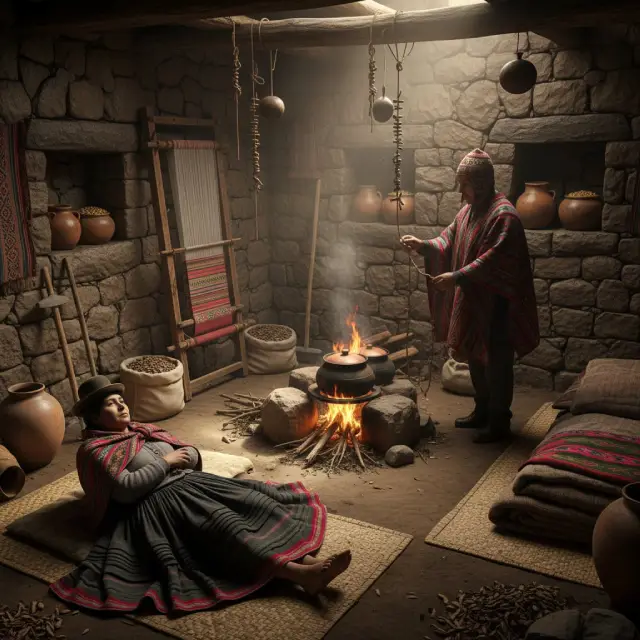
The messenger arrived at dusk, his feet covered in red dust, his shoulders hunched under the weight of an empty *ch’uspa*. He held out a coca leaf folded three times, marked with a single knot—black, tight, offering no possible reply.
“Come. The house breathes too heavily.”
The man who received the message asked no questions. He tied his woolen cloak, took a walking stick carved from *q’euña*, and set off eastward, where the clouds cling to the ridges like mourning veils.
He walked for seven days. On the eighth, he saw the house.
It stood on a rocky spur, above a lake whose waters were so black they seemed to swallow the light. Built without mortar, like all the works of the Ancients, it stood by the will of the stones alone—or perhaps by that of the mountain that had borne it. Its walls, once straight, now leaned inward, as if the house were folding in on itself, like a body curling up to die.
No dog barked. No llama raised its head. Only the wind whistled through the cracks, a hoarse, uneven breath.
Illari waited for him on the threshold. He wore a faded tunic, his hair long and tangled, his eyes hollow from sleepless nights. He didn't greet her. He simply gestured: come in.
Inside, everything was in order. The clay jars were lined up. The carpets were woven with celestial serpent motifs. The quipus hung near the window, their cords motionless despite the wind. But the air was heavy, thick as ash. And the floor, cold even in the middle of the day.
Killa did not come to meet them. She remained in the back room, the one overlooking the precipice. She was barely visible, sitting by the unlit hearth, her hands resting on her knees, her eyelids closed. She ate nothing but cantuta petals, the sacred flower of the Incas. She drank only the morning water, collected before the sun touched the earth.
The days passed. The visitor observed. He saw Illari walk barefoot on the flagstones, as if searching for a vibration. He saw him kneel before a crack in the west wall, leaving an offering of coca, chicha, and tears. He saw Killa, at night, go out naked into the patio, raise her arms toward the moon, and remain there until dawn, motionless as a statue of salt.
The house was changing.
The stones oozed a dark, almost black water, leaving streaks like veins. The doors closed by themselves. Sometimes, in the dead of night, a rumble rose from the foundations—not an earthquake, no, but a low growl, as if the earth dreamed of a time when people still knew how to pray.
One morning, the visitor found Illari kneeling before the family altar, his hands covered in earth. He had dug beneath the flagstones. There, in a stone niche, lay a small clay *conopa*—a figurine of a pregnant woman, her eyes closed, her hands folded across her belly. Their mother's. The one who had never been returned to Pachamama.
Illari clutched it to his chest. Then he broke it.
That evening, Killa left her room for the first time in weeks. She took the broken *conopa* and scattered its dust in the lake. Then she returned, sat down beside her brother, and rested her head on his shoulder. They remained like that, silent, as the wind grew colder and heavier.
The moon entered the shadows.
It was an eclipse.
The sky clouded over. The stars vanished. Even the *apu*, the sacred mountains, seemed to hold their breath.
Killa donned her mother's tunic—midnight blue, edged with silver, embroidered with forgotten constellations. She walked to the *ushnu*, the central altar of the patio, and lay down upon it, her hands clasped like those of the *conopa*. Illari, standing beside her, untied the lineage's *quipus*, one by one, and cast them into the fire. Each burning knot released a whisper—the names of ancestors, the harvest dates, the lost prayers.
When the last ash fell, the house groaned.
Not a cry. Not a clatter. A deep sigh, rising from the earth's core, as if it were finally breathing its last.
The walls cracked. The flagstones lifted. The stones, one by one, broke away and rolled gently toward the void, like tears.
The visitor ran, not out of fear, but out of respect. He didn't look back.
In the morning, he stood on the opposite shore of the lake. Up there, nothing remained. Only a jumble of disordered stones, barely visible in the mist. The lake itself was calm. Too calm. Not a ripple. Not a reflection.
But in the wind, sometimes, when the silence is perfect, you can still hear two voices—one deep, the other soft—singing the same *harawi*, the one the ancients reserved for the end of the world:
We are not dead.
We have become stone again.
We have not left.
We have become mountain again.



