The Breath of the Fjord
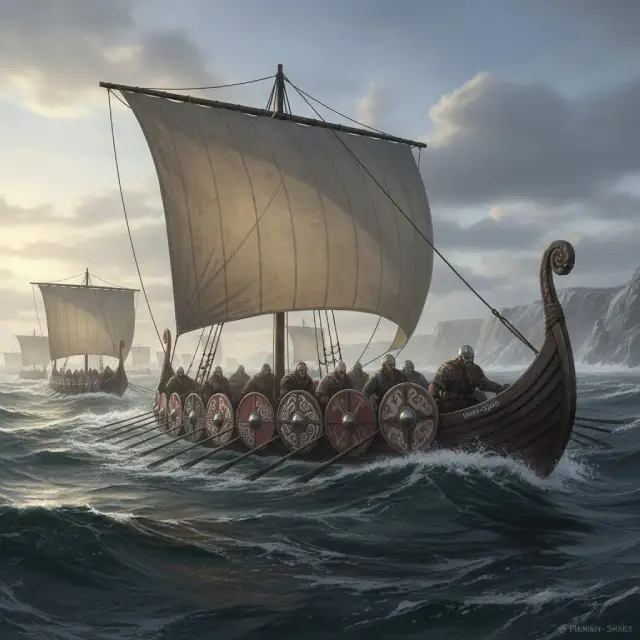
 he icy north wind rushed into the longships that cut through the dark waters of the English Channel. On the deck of the "Hrafn-Skjald," the long, square-rigged vessel with multiple oars, the pale sun reflected off shields engraved with protective runes. Three figures dominated the scene: Jarl Ragnvald Sigurðsson, leader of a small but formidable band of warriors; Thora "the Wise," his sister, widow of the late Eirikr Håkonsson and keeper of oral traditions; and Leif Kari, an ambitious young karls, son of a farmer from the Aurland valley.
 agnvald, clad in an indigo-dyed wool tunic and a wolf-fur cloak, carried at his belt a broadsword forged in Ulfheim by the region's legendary smith. His gaze, sharp as the ice on an iceberg, scanned the horizon where the verdant hills bordered the Northwest Sea, which the locals then called Neustria. The sagas told of lands inhabited by Franks and Gauls, rich in pastures and fortified villages.
"We have not come to plunder," Ragnvald declared, his voice echoing like the thunder of a summer storm. "We have come to establish a new heim—a home, a hearth." He signaled to Thora, who took from a leather bag a small runestone engraved with the inscription: “Þat er þat þér er” (“That which is destined to be”). She placed it on the deck, a symbol of the protection of the gods Ægir and Freyja.
hora, a few years older, bore the marks of the rite of passage: a necklace of amber beads and a silver brooch depicting Thor's hammer. She told the young men how their ancestors, before the great exodus of 793, had sailed along the British coast, establishing settlements in Dublin and York. “Our ancestors learned to read the stars, to interpret the signs of the wind, to honor the spirits of the forests and the seas,” she explained, recalling the blót—sacrifices of oxen or boars to appease the deities before each expedition. Leif, still covered in the dust of the road, looked up at the longship moored near the shore. He was born into the class of karls, the free people who cultivated the land, but dreamed of being a member of the jarl’s personal guard. His mother, Astrid, had taught him the skald songs, those epic poems that glorified the exploits of the ancestors. That evening, he recited a verse:
“Når havet ruller, og stormen brøler, Vår ære vokser på hver bølge som slår.”
The men around him nodded, recognizing the rhythm of the dróttkvætt, a poetic form reserved for nobles.
 s the sun sank behind the cliffs of the Opal Coast, the scouts reported the presence of a Frankish burh, a fort made of wood and stone, guarded by a garrison of milites. Ragnvald decided to send a delegation of hirdmen to negotiate, following the Viking custom of exchanging gifts to seal an alliance or test the goodwill of the adversary.
“We will arrive in Bayeux tomorrow at dawn,” announced Ragnvald. “If the Franks accept our gifts, we will share the land. If not, we will show the fury of our axes and the strength of our shields.” The clash of weapons and the cawing of ravens formed a sonic tapestry that enveloped the group. The night stretched on, and by the flickering light of a torch, amid the scent of smoked fish, dreams of conquest and a new home took shape in the minds of these men and women who had come from a world of ice and fire.
 n the early morning mist, the coast opened like a grey-green chasm, bristling with dunes and mud-brick huts. Leif's oar creaked in its toft, the swollen wood scraping against the mortise, and each stroke sent shivers through his shoulders. In the distance, the burh's palisade raised its dark stakes against the dawn, an unfamiliar silhouette, but Leif felt the familiar call of challenge. One day, he thought, he would be the one commanding a ship, he would be the one deciding the fate of a village—it would all come down to a few words, a handful of shards of steel, the look of a leader. He scrutinized Ragnvald, who stood as straight as a highland pine, and waited for the signal.
agnvald addressed his companions. The delegation would set off on foot, five men selected for their skill with words as well as with the axe. Leif was chosen, an honor tinged with doubt: why him? He had never proven himself in a real battle, only in organized fights designed to eliminate the weak rather than glorify the strong. Would he be sent "to a loss," precisely because he wasn't one of those powerful warriors the clan couldn't do without? He had to admit that he knew nothing of Ragnvald's strategy. He also knew very little about the Franks, except that they were jealous of their lands, quick to burn what they couldn't defend.
Ils marchèrent jusqu’au buhr.
Les défenseurs de Bayeux regardaient s’approcher les vikings. Leurs armes n’étaient pas brandies, ils ne criaient pas, et ils étaient trop peu nombreux pour représenter une menace.
 eif forced himself to tighten his grip on the handle of his axe-beard (Skeggöx), carefully letting it hang down without appearing threatening, as Ragnvald had ordered. He knew his place in the delegation: to walk a few paces behind the jarl, but not directly behind Thora the Wise, who always walked behind to better observe. He tried to keep his head high, even though he could feel the veterans' eyes on the back of his neck. The wind blew the smoke from a nearby house against his skin—or what was left of it, for the gaping roofs and collapsed walls spoke of fires older than their own ship had arrived. The Franks seemed to protect their buhr without fear or hesitation. They waited. The reputation of the Vikings, and especially of the berserker warriors, sometimes opened buhrs for them, but Bayeux did not seem to be one of them.
he group advanced until they were within earshot.
Ragnald and Thora moved even closer while the others remained motionless behind. Ragnald spoke, and Thora translated.
Although unfamiliar with peace talks, Ragnald presented his gift, his token of goodwill: Leif.
Leif's mouth nearly opened in surprise. He didn't protest, didn't flee. He greeted the defenders without his expression betraying any emotion. He was a karl: disciplined, trusting in his leader, certain that being a gift today would, if he survived, secure his place among the hirdmen. And perhaps one day he would even be the jarl. Only Odin knew.



