The twilight of a lost era
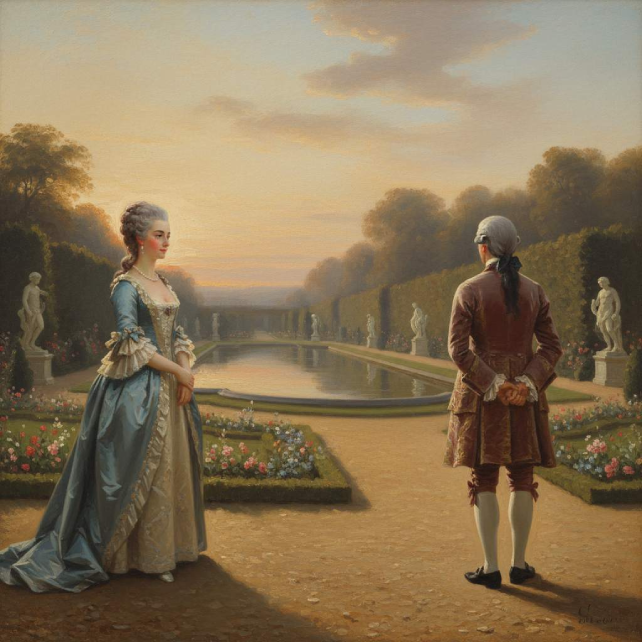

In the wood-paneled apartments on the rue de Tournon, Charles-Édouard de Valcourt reread, with a mixture of pride and apprehension, the engagement letters his father had exchanged with the House of Montbrison. The son of a line of magistrates, educated at the Sorbonne, admired for his integrity and prudence, he embodied what Paris expected of a young advisor to Parliament. His marriage to Adélaïde de Montbrison—pearl-gray satin gown, downcast gaze, impeccable conversation—was to seal the perfect alliance between ambition and virtue. She pleased him as much as a cloudless sky: one confides in her without passion, but with gratitude.

It was one winter evening in the Faubourg Saint-Germain that she appeared. Madame de Beaumont—Éléonore to the more adventurous—was returning from Italy like a butterfly lost in a lace salon. Rumor, perfume, radiance: everything about her was unsettling.
Her Italian-style dresses, with their low necklines that seemed foreign to Parisian modesty, caused the duchesses to murmur.
She spoke of Rousseau with a fire that seemed to come from some Tuscan volcano.
Charles-Édouard, initially disconcerted, felt something older than reason crack beneath his principles: the desire to be free.

As the weeks passed, Adélaïde's image gently dissolved into a haze of propriety, while Éléonore emerged, vibrant and commanding, like a ray of dawn upon a fossilized world.
She spoke of new ideas—tolerance, sensitivity, dignity of heart—with that feminine audacity that Paris granted only to actresses. Charles-Édouard, for his part, oscillated between the cold serenity of duty and the tepid intoxication of discovery.
He read Voltaire in secret, corrected Montesquieu's memoirs under his magistrate's desk—like an adolescent guilty of daydreaming instead of obeying.

They saw each other everywhere and nowhere: in the paths of the Luxembourg Gardens, in the shadows of the boxes at the Comédie-Française, or before the gilded sideboards of philosophical salons.
Their correspondence, entrusted to an old, one-eyed servant, was as much sermon as declaration.
Nothing carnal ever disturbed their bond; but the fever contained in their silences was worth a thousand vows.
She often laughed: “You see, Monsieur de Valcourt, we are prisoners of a century that mistakes virtue for immobility.”
And he, unable to choose between two virtues, remained silent—for words would have betrayed him.

When the rumors became threatening, Éléonore made the decision dictated by her pride.
One night, she summoned Charles-Édouard to her townhouse on the rue du Bac.
She wore a simple, almost austere dress, as if to erase the memory of their forbidden reveries. “I’m leaving,” she said. “I’ve realized that our happiness here would only be an elegant form of unhappiness.” She refused his money, his name, and even his protection: “Freedom, my friend, cannot be bought; it must be won, alone.” The next day, it was learned that she had taken the road south; her carriage crossed the border at Modane, and the century was already turning its page.

Many years passed.
The splendor of Versailles had faded beneath the dust of the Revolution.
The titles, the coats of arms, the wigs had disappeared, like those portraits that pale in the sunlight of progress. Charles-Édouard, aged, widowed, and childless, left for Italy, still searching for a reason to believe in beauty.
In Florence, one autumn evening, he found Éléonore again in a villa gently abandoned, fragrant with cypresses. Her hair was silver, but her gaze—still bright—recalled the fire that society had tried to extinguish.
They spoke at length, not of what they had lost, but of what they had saved: the untarnished memory of an innocence that no century could ever take from them.
Twilight was falling.
“See,” she murmured, “our time has not been in vain.” He nodded,and, in Eleanor’s eyes, he thought he recognized the light of the first day.



