(1)-The Mystery of Edwin Drood (summary)
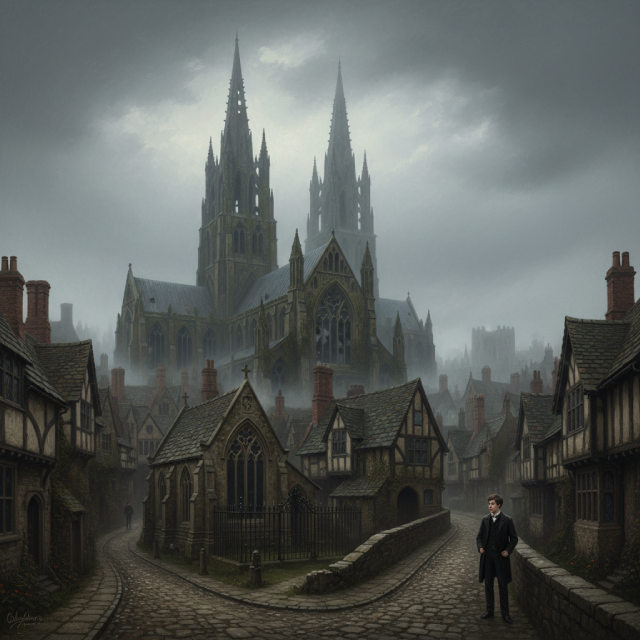
In the perpetual mists of Cloisterham, a small cathedral city nestled in the Kentish hills, time seemed to have stood still somewhere between the Middle Ages and a melancholy eternity. The cathedral towers stood like spectral sentinels above the slate roofs, their eroded gargoyles peering down the winding alleyways where shadow and light played hide-and-seek with the secrets of the living. It was a place where the past weighed heavily on every stone, where the bells tolled with a mournful solemnity, and where the mortuary chapel still breathed the prayers of bygone centuries.
At the heart of this Gothic atmosphere lived Edwin Drood, a young engineer destined for a brilliant future in the Eastern colonies. Handsome, carefree, perhaps a little too confident in his good fortune, he carried on his shoulders the weight of a commitment he had never chosen: his engagement to Rosa Bud, an orphan of ethereal grace and unsettling innocence. Their fathers, close friends now deceased, had sealed this union in a joint will, making their mutual affection a posthumous duty. But love cannot be commanded like a notarized bequest. Edwin and Rosa, though they cherished each other as one cherishes a brother or sister, understood that their hearts would never beat as one. In a private conversation filled with relief and tenderness, they decided to break off the engagement—but to keep this decision secret, fearing to hurt those who had placed so much hope in their union. Around this fleeting couple gravitated a constellation of characters, each with their own inner darkness.
John Jasper, Edwin's uncle and guardian, was the living enigma of Cloisterham. As Kapellmeister at the cathedral, he presided over services with an almost mystical fervor, his fingers flying across the organ keys as if conversing with the afterlife. Outwardly, he was a respectable man, even ascetic, draped in the dignity of his position. But behind this mask lay an abyss. London nights knew him by another face: that of an opium smoker, prostrate in squalid dives where the acrid fumes offered him visions he found nowhere else. And in these toxic reveries, an obsession consumed him: Rosa Bud. He loved her with a sick, possessive, devouring love—a love that transformed into venomous hatred every time he thought of Edwin, that too-lucky nephew who possessed (or so he believed) what he coveted. Jasper was a man divided in two, and this inner turmoil threatened to engulf all who came near him. Mr. Grewgious, Rosa's guardian, on the other hand, embodies gruff rectitude and awkward kindness. A London solicitor of scrupulous honesty, he watches over his ward with a tenderness he conceals beneath his terse manner and impassioned sentences. Beneath his angular exterior and apparent pragmatism, Grewgious hides a heart capable of absolute devotion. When he senses the danger lurking around Rosa—particularly that posed by Jasper—he displays a discreet but relentless vigilance, ready to do anything to protect the one he considers almost his own daughter.
Then Neville and Helena Landless arrive in Cloisterham, twins with dark complexions and smoldering eyes, exiled from Ceylon carrying the burden of a troubled childhood. Impetuous and brooding, Neville bears the scars of a violent past: raised by a tyrannical stepfather, he learned to defend himself with his fists before he learned to defend himself with words. But beneath this rough exterior beats a noble heart, thirsting for justice and capable of fierce loyalty. His sister Helena, with her dark beauty and sharp intellect, watches over him like a lioness over her cub. From the moment they arrive, Neville feels an immediate connection with Rosa—perhaps even something deeper. This attraction does not escape Jasper, who immediately sees it as both a threat and an opportunity. Reverend Septimus Crisparkle, Neville's guardian, embodies Christian goodness in its purest and most naive form. Athletic, jovial, and blindly optimistic, he believes in the good in everyone with unwavering faith. This innocence makes him a valuable ally but also an easy victim for manipulators.
And finally, appearing in the last chapters like a theatrical apparition, is Dick Datchery—or whoever calls himself that. This man with a shaved head hidden beneath a white wig, his snowy beard obviously fake, settles in Cloisterham with the nonchalant air of a retiree seeking tranquility. But his eyes never stop observing, noting, stalking. He lodges opposite Jasper's house and mysteriously counts chalk marks on his bedroom wall. Who is he really? A detective in disguise? An old friend of Edwin's? Or perhaps someone much closer to the tragedy than anyone could imagine? The catastrophe occurs on Christmas Eve, the night meant to celebrate peace and reconciliation. Edwin is having dinner at his uncle Jasper's house. The two men drink together, exchange confidences—or at least Edwin thinks he is. Jasper, however, is playing a role, every gesture calculated, every smile measured. After dinner, Edwin went out into the freezing night for one last walk. And then... nothing. The young man vanished like smoke in the December fog.
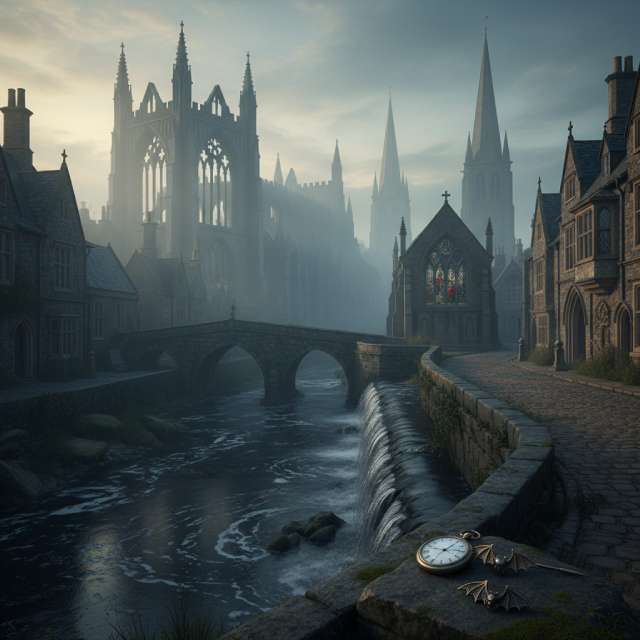
The next day, his watch and tie pin were found near the Weir, the old weir by the river where the water swirled in deep, dark eddies. But no body. No sign of a struggle. Just these abandoned objects that seemed to scream a contradictory message. Public opinion in Cloisterham, swayed by Jasper's calculated lamentations, immediately turned against Neville Landless. Hadn't he had a violent altercation with Edwin a few days earlier? Wasn't he that hot-blooded young man, that half-wild colonial? Jasper mourned his nephew with perfect theatricality, but his veiled accusations transformed the collective grief into fury. Neville, exonerated for lack of evidence, had to flee London, his name forever tarnished.
Yet, cracks in the official narrative appeared for those who knew how to look. In the haze of opium, Jasper whispered to an old woman the description of a murder—that of a young man strangled, his body hidden in the secret recesses of the cathedral. A perfect crime, he said, a crime whose perpetrator no one would ever suspect. Was it a fantasy or a disguised confession?
And Datchery continues his strange game, following Jasper like a shadow, noting his every outing, every visitor, every suspicious moment. The truth lies hidden somewhere in the ancient stones of Cloisterham, in the forgotten crypts of the cathedral, in furtive glances and heavy silences. It is there that Dickens laid down his pen forever, leaving his readers on the edge of the precipice, between suspicion and certainty, between death and perhaps... the hope of resurrection.



