The Art of Kintsugi
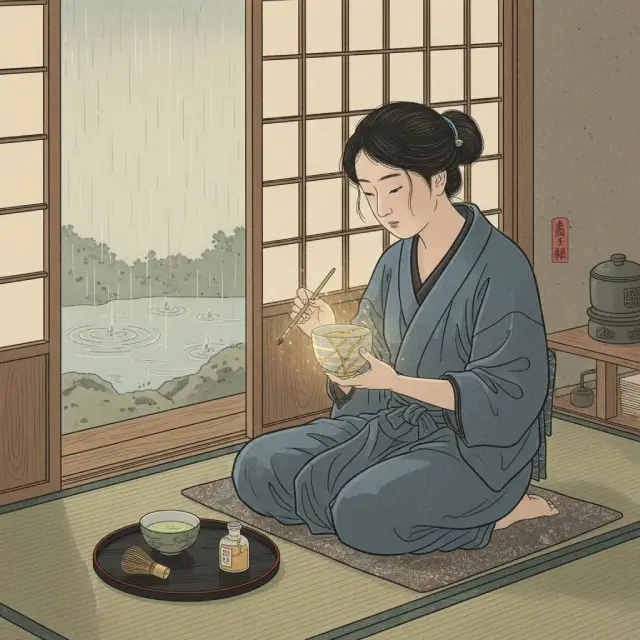
Kyoto slept beneath a fine rain, slow and endless. Each drop bounced off the glazed roof tiles, slid along the branches of flowerless cherry trees, and merged with the sifted earth of the imperial gardens. In a modest house in the north of the city, not far from Shōkoku-ji temple, a woman turned a porcelain cup on a silent wheel. Her hands, stained with clay, never trembled. She never signed her works. She never sold under her own name.
She was called only "the potter of Seto," though she had not returned there for more than twenty years.
That morning, she was not shaping. She was repairing.
The cup was ancient, thin as a dragonfly's wing, cracked in three places after an unfortunate fall. Its owner—an old servant of the Imperial Court—had brought it in silence, wrapped in a linen cloth worn to the weft. "It has touched His Majesty's lips," he had whispered, as if that were enough to explain everything.
The woman had not replied. She had only nodded, placed the cup on a straw mat, and lit the small brazier that heated the urushi lacquer mixed with gold powder.
For three days, she spoke to no one. She did not leave her house. She did nothing but contemplate the crack, trace the outline of the breaks with her fingertip, then apply the lacquer with a weasel-hair brush. Each gesture was a prayer. Each gold ornament, an offering.
On the fourth day, Emperor Sakura—an honorary title given to him by poets for his tendency to shed petals in silence—received an unusual invitation. No minister, no shogun, not even a Shinto priest. Only a tea bowl, placed at the entrance to his private pavilion, with a note folded in origami: So that Your Majesty may drink, not in perfection, but in memory.
He recognized the cup immediately. The one he had dropped one autumn evening, after learning of the death of his young wife, whose eyes resembled camellia petals drenched in dew. He had not wept that day. He had said nothing. He had only surrendered to the mute humiliation of that gesture—an emperor who cannot even hold a cup.
But now, the porcelain returned to him—not intact, not new, but healed. The cracks had been traced in gold, as if light itself had sewn its fragments back together. He poured the matcha tea. The green foam trembled slightly in the repaired bowl. He drank. And for the first time in years, he felt something rise in his chest. Not pain. Not joy. But a form of peace—the kind found not in the absence of brokenness, but in the way one carries it.
That very evening, he summoned the potter. Not to reward her—he knew she would refuse. But to say to her, simply, while gazing at the garden under the moon: "Thank you for showing an old man that what is broken can still serve."
She did not reply. She did not even look at him. But she bowed her head slightly, as reeds do before the north wind.
And that night, in the silent palace, the Emperor drank again from the repaired cup. Not to forget. But to continue.
The potter never returned to Seto. She continued her work in the shadows, repairing bowls, vases, sometimes hearts. It is said that she taught kintsugi to young orphan girls, not as a decorative art, but as a philosophy: all that has suffered deserves to be seen, not hidden.
Emperor Sakura lived another twelve years. He wrote poems, planted cherry trees, and always used the same golden cup when he received his guests. He never spoke of that woman. But each spring, an anonymous offering of matcha tea was left in front of the potter's small workshop—accompanied by a plum blossom, still damp with dew.



