(2) The Cypress Pavilion
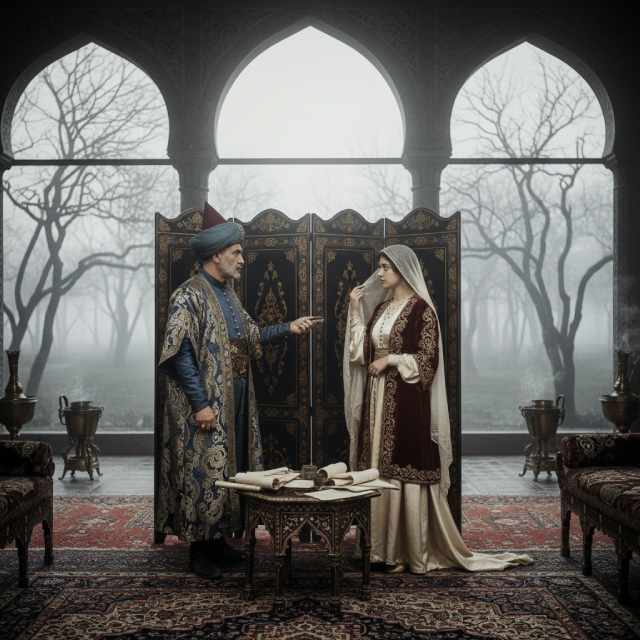
Zehra was summoned at dawn. A page knocked three times, without waiting for an answer; fluttering behind him, the scent of a recently extinguished lamp filled the room. The sky over the Bosphorus unfolded in a mercury gray. She understood before he spoke: no one summoned a calligrapher at this hour, except for an inventory… or for an interrogation.
She adjusted her veil, her fingers trembling, and followed the page through the corridors still heavy with sleep. The carpets muffled every step. As they descended toward the formal reception rooms, the walls became colder, less ornate. She thought of all the anonymous hands that had adorned these ceilings, of those artisans whose names had been lost in the very gilding of their work; She too risked dissolving in this way, in the veneer of a crime she hadn't committed.
The cypress pavilion's hall opened onto the winter garden, where trees sculpted with shadows were shrouded in mist. In the center, behind a lacquered screen, stood three figures. One spoke in a soft, too soft voice: a new vizier, in charge of court affairs. He read her name without looking at her, then slowly stated that illicit copies had been found; subversive verses mixed with love poems. There was talk of a code hidden between the capital letters, a "network of Letters."
Zehra felt the sweat chill her back. She thought of the stone lifted in the pavilion, the red petal slipped into her inkwell. Was it betrayal, or a plea?
The vizier continued:
“The hand that can reproduce a secret is the same hand that can invent one.”
She made no reply. He demanded to see her work. Her scrolls were brought in: the precise beauty of her lines, their almost monastic discipline, seemed her best defense. She was sent back to the harem, “under observation.” A temporary reprieve that sounded like a delay to punishment.
That evening, she didn't return to her writing. She climbed to the loggia, where the servants never went, and there, kneeling against the cold marble, she searched for the Pavilion of the Spirits—a small dome at the foot of the Bosphorus, where it was said that the insurgents' boats, cast adrift at sea, still drifted beneath the waters.
A breeze carried the scent of salt and fire. Below, a figure stood motionless, almost dissolved in the mist; she thought she recognized the shape of a hooded cloak, that of a scribe she had often seen in the archives wing. When he looked up, she thought she saw the gleam of a broken star embroidered on his sleeve.
Upon her return, a box awaited her on her table. Inside, a single sheet of paper:
“What you have written is already circulating. Don't look for who betrayed you. Look for why.”
From then on, Zehra lived in a state of constant tension. Her hands trembled almost imperceptibly, like a trapped butterfly. She began to write even more slowly, interspersing the court poems with minute variations in style: a crooked letter, a broken stroke, a tiny inversion—an invisible code, intended for whoever might be able to see it.
The favorites, sheltered in their perfumes, complained about her newfound slowness. She was forced to change seats, then to share her table with another calligrapher, younger, docile, who spoke in a low voice and always wore a veil that was too long. Zehra understood, from the very first hour, that the young girl was not truly an apprentice: her fingers smelled neither of ink nor resin, but of metal.”
The surveillance became more intense. Yet one night, as she penned love poems, pouring half her fear into each curve, the young "apprentice" brushed her wrist and slipped a tiny object beneath the page: a simple ring, adorned with a chipped star.
Zehra's world shifted. The messenger was on their side; or at least, not the sultan's.
In the days that followed, through the whispers of the palace, the young woman began to pick up on new signs: furtive smiles from the maids, a note scribbled on a corner of the tablecloth before being removed, broken quills arranged in a crescent shape. Everything pointed to the proximity of a network—invisible, yet alive, pulsating beneath the silk of power.
One rainy evening, as the reflections of the Bosphorus faded in the flashes of lightning, the messenger came again, pale in the lamplight. Without a word, she placed an empty envelope on Zehra's table; inside, beneath the lining, lay a shard of ceramic painted with the same motif as a tile in the harem. The calligrapher understood: she was being ordered to return to the original hiding place.
She waited until everything was plunged into the oily silence of midnight. The palace slept like a sated animal. Zehra walked barefoot to the tile room. The air smelled of damp dust. She pushed aside the cracked tile—the same gesture as the first time.
But this time, the hiding place was full. Not of letters, but of a fresh scroll, still damp with ink, bearing a new seal: the eagle of the imperial ministry.
A trap.
Before she had time to think, a shadow emerged from behind the column; the vizier. He was holding the box where she kept her copies. He gazed at her for a long time—his gaze more sorrowful than hostile—then, in an almost tender tone,
“You should have been a poet, not an accomplice.”
She wanted to speak, but the sound of a fight suddenly erupted further away in the courtyard: shouts, clashing metal, muffled explosions. The vizier’s face froze; he understood before she did. The plot he thought he was thwarting had just exploded around them.
In the confusion, Zehra seized the scroll and fled through the Hall of Mirrors. The flames of the reflected torches seemed like hundreds of tongues raised toward her.
In the distance, the dome of the Pavilion of Spirits was already burning. Figures were running toward the boats on the shore. A cry—the name she had never dared utter—was lost in the wind.
She reached the lower gardens, panting. The scroll beat against her chest. She knew that, whatever the outcome, the ink she carried now determined a destiny greater than herself.
Behind her, the palace rumbled, wounded. The water rose to her ankles. She crossed the last bed of jasmine… and disappeared into the mist of the Bosphorus.



