Cagliostro, the Alchemist of Appearances
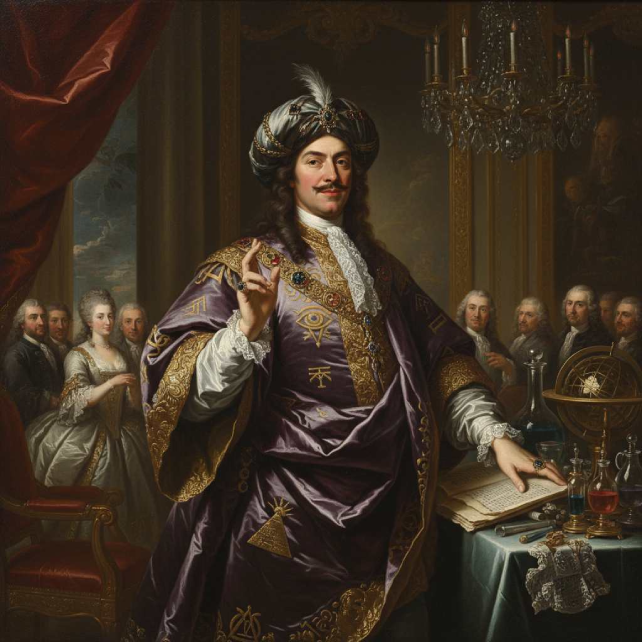
More than a mere swindler, Cagliostro was an artist of illusion, a virtuoso who understood the flaws of his era better than anyone else. In a century that prided itself on reason, he proved that elegant mystery was more seductive than prosaic truth. His masterpiece? To have invented himself, to have transformed Giuseppe Balsamo into a legendary count, and to have made his entire life a magnificent spectacle.
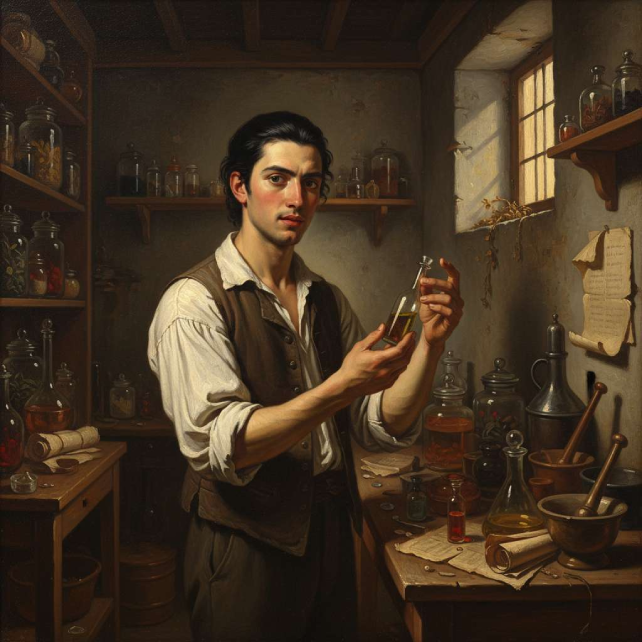
One is rarely born a count. Giuseppe Balsamo knew this better than anyone, having been born in 1743 in a disreputable alley in Palermo, amidst the cries of merchants and the acrid smell of tanneries. His mother, a pious woman burdened by poverty, entrusted him to the care of an apothecary uncle, hoping the child would learn an honest trade. Young Giuseppe did indeed learn a great deal—perhaps even too much for his own good. At his uncle's, among the vials and alembics, he discovered less science itself than its theatrical potential. Powders that change color, liquids that mysteriously fume, chemical reactions that fascinate the ignorant: all this constituted a far more lucrative spectacle than an apothecary's shop. At fifteen, expelled from the seminary for forging a certificate of completion with promising skill, Giuseppe realized that the world belonged not to scholars, but to convincing illusionists.
He first traveled throughout Italy selling fake relics and parchments supposedly revealing the location of buried treasure. The venture was risky but formative. In Messina, he sold a credulous goldsmith a map leading to a chest filled with gold, guarded—naturally—by spirits that first had to be appeased with costly ceremonies. The goldsmith took the bait. Giuseppe ran off with the money from the ceremonies, leaving the man to dig in vain in a Sicilian field under the full moon.
But a provincial swindler is nothing. Giuseppe dreamed of a grander stage, a more refined audience. In Rome, in 1768, he married Lorenza Feliciani, a young Roman beauty whose charm admirably complemented his own talents. Together, they formed a remarkable partnership: she attracted attention and inspired confidence, while he orchestrated illusions. Shortly after their marriage, Giuseppe Balsamo disappeared, giving way to a far more impressive creation: Count Alessandro di Cagliostro.
The title was purely decorative, of course, but pronounced with enough assurance that no one dared question it. Cagliostro claimed to have traveled to Egypt, Arabia, and Persia, to have studied with the sages of Medina and the mystics of Cairo. He asserted that he possessed the secret of the philosopher's stone, the elixir of life, and, incidentally, the recipe for an ointment that would preserve beauty eternally. For a man who had scarcely left the Mediterranean, it was an ambitious biography.
The couple traveled throughout Europe, from court to court, from salon to salon. Cagliostro presented himself as an alchemist, healer, and Freemason initiated into Egyptian mysteries. He founded Masonic lodges of the "Egyptian rite," blending pharaonic symbols and esoteric rituals with admirable nonchalance, inventing them as he went along. Aristocrats, weary of their gilded lives, flocked to be admitted to these mysterious circles where spiritual regeneration and age-old secrets were promised.
In London, he treated various prominent figures—with varying degrees of success. In Strasbourg, he impressed Cardinal de Rohan, a prince-bishop fascinated by the occult and remarkably lacking in judgment. Cagliostro predicted his future, invoked spirits amidst clouds of incense, and, above all, gained his absolute trust. This friendship with a prince of the Church was to open the doors of Versailles to him.
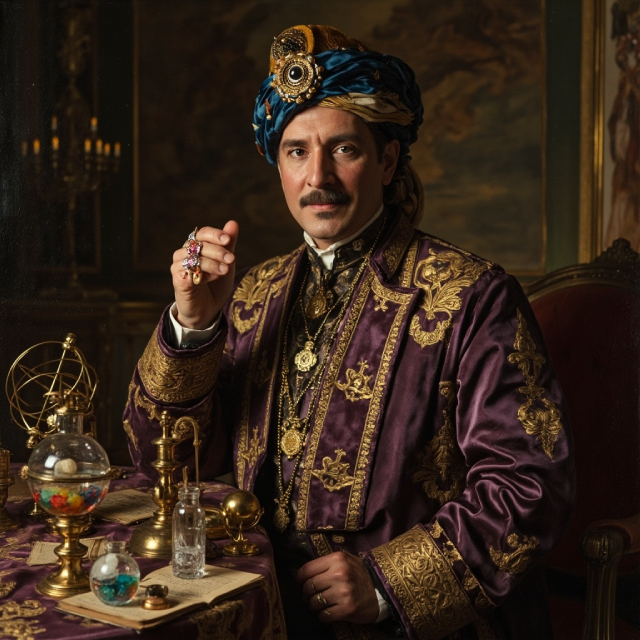
Paris in the 1780s was the ideal stage for a man of his ilk. The court was living its last years of carefree abandon, oscillating between frivolity and a deep-seated anxiety. Boredom reigned supreme at Versailles, and boredom is a charlatan's best friend. Cagliostro organized spectacular séances there, claiming to transmute metals, rejuvenate the elderly, and communicate with the dead. He asserted that he was three thousand years old and recalled, with touching precision, conversations he claimed to have had with the Queen of Sheba.
Marie Antoinette herself received him, albeit with some reservations. The queen, despite her reputation for frivolity, possessed more common sense than her courtiers. She found Cagliostro amusing but unconvincing—which proves that she was perhaps not as foolish as history has sometimes claimed.
It was precisely this friendship with Cardinal de Rohan that precipitated Cagliostro's downfall. In 1785, the Affair of the Necklace erupted, one of the most resounding scandals of the century. An adventuress named Jeanne de La Motte had managed to convince the cardinal that Marie Antoinette secretly wished to acquire a fabulously valuable diamond necklace. The cardinal, hoping to regain the favor of the queen who despised him, had guaranteed the purchase. The necklace was delivered to a woman impersonating Marie Antoinette, then dismembered and sold.
Cagliostro had probably played only a minor role in this swindle, but his friendship with the cardinal was enough to implicate him. He was thrown into the Bastille with the other protagonists. The ensuing trial captivated all of Paris. Cagliostro, ever the excellent actor, defended himself with gusto, proclaiming his innocence and denouncing the conspiracy of which he claimed to be a victim. He was ultimately acquitted, but the scandal had tarnished his reputation. Paris, which had once adored him, rejected him with the fickle cruelty of a mob. Driven from France, Cagliostro wandered once more across Europe, but the magic was gone. The doors that had once opened so readily remained closed. The man who had seduced cardinals and fascinated princes found himself a nuisance, a burden, and suspect. In 1789, in a fit of excessive optimism or despair, he made the fatal mistake of going to Rome to found a Masonic lodge.
In Rome, the seat of the papacy and the capital of Catholic orthodoxy, the Freemason was a heretic by definition, and the alchemist a sorcerer by vocation. Cagliostro was arrested, tried by the Inquisition, and sentenced to death—a sentence commuted to life imprisonment by papal clemency. He ended his days in the fortress of San Leo, perched on a rock in the Apennines. The count, who claimed to be three thousand years old, died in 1795, at the age of fifty-two, in a damp dungeon, far from gilded salons and admiring crowds.
What should we remember about Cagliostro? Certainly not an alchemist—he only ever transmuted credulity into gold. Nor an Egyptian sage—he probably never left Christianity. But perhaps, in his own way, he was an artist of deception, a virtuoso of illusion who understood the flaws of his era better than his contemporaries. In a century that reveled in reason and Enlightenment ideals, he demonstrated that elegant obscurantism was more seductive than prosaic truth.
Portraits of him remain, in which he poses in oriental robes, his gaze piercing, surrounded by alchemical instruments. Europe has produced charlatans by the thousands. But how many have managed to transform a miserable childhood into a golden legend, a Sicilian name into a count's title, and a complete lack of power into universal prestige? Giuseppe Balsamo invented Cagliostro from scratch, and this creation was perhaps his only true masterpiece.
**********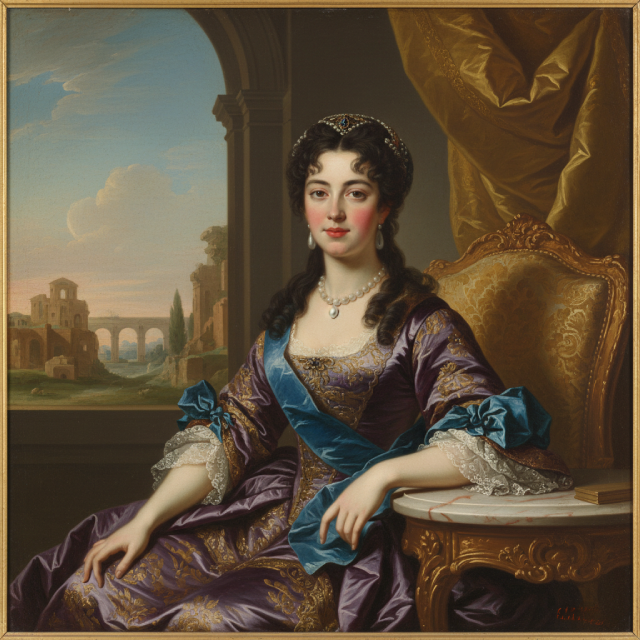 Lorenza Feliciani, who became Countess Cagliostro through her marriage to the imposter, met a fate as tragic as her husband's, though in a different way.
When he was arrested in Rome in 1789, she too was imprisoned. During the trial before the Inquisition, she testified against her husband—either under duress or out of resentment accumulated after twenty years of serving as bait in his swindles. One can imagine that a lifetime of playing the mysterious beauty to lure unsuspecting victims into Giuseppe's nets could have wearyed even the most compliant of wives.
Her statements were damning. She revealed Cagliostro's true identity, confirmed that he was nothing more than a Sicilian charlatan without titles or authority, and exposed the mechanisms of their frauds. This testimony contributed significantly to her husband's condemnation. The Inquisition, having obtained what it desired, showed relative leniency toward Lorenza. She was not condemned to death, but confined to a Roman convent, the Convent of Santa Apollonia, to atone for her sins and lead a life of perpetual penance. A punishment that, for a woman accustomed to the gilded salons of Europe and admiring glances, must have felt like a slow death.
Her trail then disappears. Some sources claim she died at the convent a few years later, around 1794 or 1795, roughly at the time Cagliostro died in his fortress. Others maintain she lived there longer, forgotten by all, the former countess reduced to a simple cloistered nun.
What is certain is that the woman who had dazzled Europe alongside her charlatan husband ended her days in obscurity and silence, confined within four walls, as much a prisoner as he was, but in a different cage. The couple, who had built a life of gilded illusions, thus ended their lives separately, each behind bars: she alive but dead to the world, he dead but immortalized by legend.
A rather ironic end for two people who had spent their lives selling dreams: they both ended up in the most brutal reality imaginable—the cold stone of papal prisons.



