Ásmundr Hjaltisson — The Last Solstice
Winter came early this year, with the slow insistence of the northern seasons. The pastures had turned to white stone; the horses wore the snow like a cloak. On the Hjaltisson farm, people walked in silence, as if their voices themselves feared freezing in the air.
Ásmundr was the second son of Einar the Faithful. He was at the age when a man knows how to wield a sword but has not yet wedded to peace. The previous winter, his elder brother, Hrolfr, had fallen to the sword of Þórolfr the Black, in a brutal raid that had taken cattle, flour, and honor. The blood spilled had never been washed away; Icelandic law, immutable and severe, demanded reparation or vengeance. But reparation cost money, cattle, land. And the Hjaltissons had nothing left to give.
It was then that Brynhildr, the dark-eyed völva, came—the one said to see in the wind what others could not see in broad daylight. She slept for three nights in the house, on skins arranged in a circle, her head facing north.
On the morning of the fourth day, she spoke.
“I dreamed of blood on the snow,” she said. “I dreamed of your son walking alone toward the hall of Þórolfr the Black, when the sun is weakest. Two men will fall before the door, and the third will be the master of the house. He will wear wealth like armor, but his fate will be more fragile than the fjord’s ice. Ásmundr will strike him, and Þórolfr will die. But Einar’s son will not see the sun set.”
No one had dared question the prophecy. Brynhildr never exaggerated, never softened, nor did she ever exaggerate. She simply spoke. This made her words heavier than stones.
She turned to Ásmundr:
“You can stay home. No one will blame you: Þórolfr has fifteen men. The law will not demand more from you than you can give.” She left the farm that very day, leaving in her wake the scent of juniper and a lingering unease.
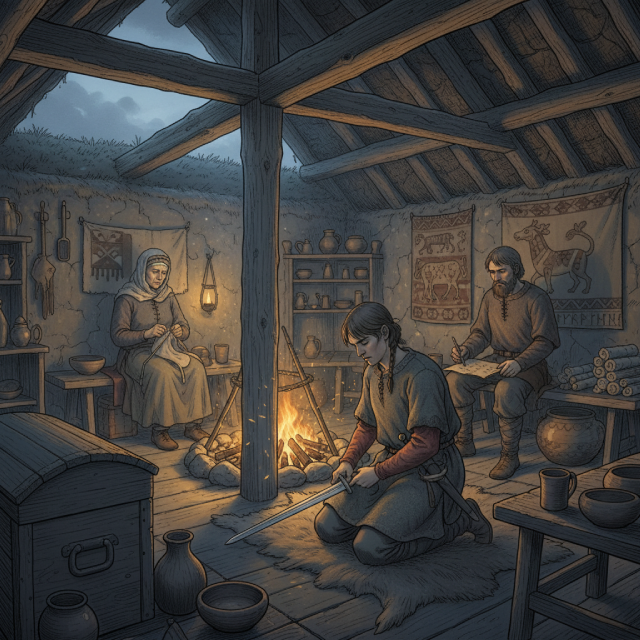
Ásmundr nodded slowly. Then he began to sharpen his sword. Every evening, as the shadows lengthened, the steady scraping of stone against steel could be heard, like a stubborn heartbeat. His mother spun wool in silence, but her hands sometimes trembled. And sometimes she wept silently, for the women of the North know the value of restraint. Einar, the father, said nothing; he watched his son, measured his gestures, weighed his destiny. And when evening came, he withdrew to the hearth with his thoughts, for he was already composing a skaldic poem that would follow his son beyond the world. The murmur of the solstice spread across the land. On neighboring farms, a goat was being sacrificed for the coming year, and the altars of the gods were being cleansed. But at the Hjaltisson's, preparations were underway for the journey of a single man.
On the morning of the solstice, Ásmundr put on his boots, fastened his cloak, and took up his sword and small shield. He greeted his father with a glance, for the men of the North know that some words are less powerful than silence. His mother placed a hand on his arm, for a brief moment—too brief to hold anything back. He walked on.
The snow crunched beneath his feet, and the wind whipped up pale eddies. Þórolfr's domain lay at the bottom of the valley, vast and rich: sturdy fences, a smoking room from which clouds of smoke rose, and above all, the great hall, where the lord feasted with his men.
When Ásmundr arrived, two guards stood before the gate. They saw him, perhaps even mocked him, for the idea of one man seeking justice against fifteen was strange and almost admirable. One raised his axe.
Ásmundr didn't speak. He walked on.
The first guard fell almost immediately, surprised by the swiftness of a man who had come to die. The second tried to retreat, but the snow betrayed him; Ásmundr struck at an angle, and blood made a dark stain on the white ground.
The great gate burst open. Þórolfr appeared, broad-shouldered, richly dressed, but with a gaze as cold as the fjords. He understood without being told. He drew his sword, descended the steps, and the two men found themselves in the courtyard, surrounded by cries of alarm.
They sized each other up, without haste. Þórolfr carried the weight of experience; Ásmundr, the certainty of destiny.
The fight was long, though no one could say exactly how long. Þórolfr's men shouted, but none dared intervene, for that would have broken their honor. Swords clashed against shields, ricocheted off chainmail rings, and bit into flesh where either left an opening.
Finally, Ásmundr feinted to the left, then struck below the ribs. Þórolfr gasped, staggered, and fell to his knees. His blood spilled onto the snow, warm like a belated offering.
The Black man attempted a final word, but his throat flushed red. He bowed in the snow, slowly, like a man falling asleep.
Ásmundr remained standing, breathless. Around him, Þórolfr's men wavered between fleeing and seeking revenge. But Icelandic law was clear: vengeance had been served. The chieftain was dead at the hand of the plaintiff. Anyone who killed Ásmundr now would be an outlaw.
No one moved.
Then Ásmundr felt a strange weight in his chest, as if the cold wanted to seep in. He understood without fear. He too fell, his face turned toward the pale solstice sky.
He died before sunset.
The body was brought back to the Hjaltisson farm. Einar received his son without tears. He still had a duty to fulfill: to give words to what the world would never explain.
That evening, before the assembled family, he recited the funeral poem:
“Under the winter sky, the son of the earth,
Ásmundr, whose blade sang the truth,
Walked toward destiny, not to flee, but so that the world might remember.
May the snow keep his step, may the wind bear his name,
Until the fjords themselves murmur in his honor.”
In the silence that followed, the flames of the hearth seemed to listen.
And so the solstice day passed. The days resumed their slow march, as if nothing had changed. But in the valley, when the wind blew from the north, some swore they could hear a name whispering between the gusts.
Ásmundr.
And no one dared forget it.



