Footsteps One Never Forgets
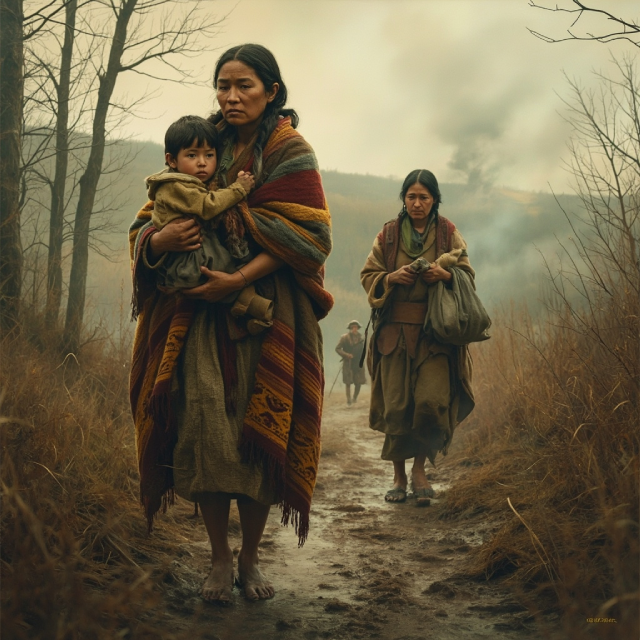
Georgia, Autumn 1838
The first thing Ahyoka noticed that morning wasn't the sound of hooves or the shouts of soldiers. It was the silence of the birds.
She stepped barefoot onto the wooden porch, still warm from the night. Dawn trembled in the branches of the black walnut tree, but no jays were perched there. Even the crickets had fallen silent. Her little sister, Naya, was still asleep, curled up under a blanket woven by their mother—the one with the water snake pattern, symbols of healing. Their grandmother, Walela, was already up, her hands plunged into a burlap sack. She was slipping in blue corn kernels, one by one, as if they could sprout in the very air.
"They're here," she said without looking up.
Ahyoka didn't reply. She knew. For weeks, rumors had been circulating: entire families torn from their fields, houses burned to the ground, men chained for refusing to sign a document they didn't understand. The Treaty of New Echota. A word that sounded like treason, uttered by those who had no right to speak on behalf of the Nation.
Boots pounded the earth. Three soldiers in pale blue uniforms, their faces grim, burst into the courtyard. One of them held up a list. He read their father's name—Tayanita—as if he were a criminal. But their father had died two winters earlier, succumbing to a fever after helping to build the school at the Moravian Mission. Ahyoka said it calmly. The man shrugged.
"It doesn't matter. You're all leaving. Gather what you can carry. One o'clock."
Walela didn't cry. She tied the bag of seeds to her belt, took the stone pipe engraved with a hummingbird—a gift from her own father on her wedding day—and wrapped Naya in the blanket. Ahyoka went to fetch the notebook. The one in which their uncle, a Yale student before illness took him, had copied excerpts from the Cherokee Constitution, prayers in syllabary, and a letter from John Ross: “We are not animals to be hunted. We are a people.”
They were led with others to an enclosure near Fort Cass. Hundreds of people were crammed inside, in the persistent drizzle. They were given spoiled corn and stagnant water. The children coughed. The old men stared at the sky as if searching for a sign that Mother Earth had abandoned them.
The departure took place in November. More than two thousand Cherokees marched, escorted by soldiers who didn't speak their language. Ahyoka carried Naya on her back. Walela walked ahead, her back straight despite her seventy years. Sometimes she sang—not loudly, just enough for the wind to hear. Ancient songs, the kind that soothe the spirits of the trees when they must be cut down.
They crossed icy rivers. Some fell, unable to get up. They were covered with a blanket and they continued. There was no time for funerals. Only whispered names, promises to repeat them one day, there, in the new land.
One evening, by a long-extinguished fire, Naya asked:
"Will we ever see our mountains again?"
Ahyoka stroked her tangled hair.
"No, little sister. But we carry their roots with us."
She didn't yet know that Naya would never see Oklahoma. That she would die in February, in a camp of frozen mud, her lips blue, still clutching a small wooden horse carved by their father. But she already knew that every step counted. That walking was an act of resistance. That surviving was a testament.
And when, finally, in the spring of 1839, the last survivors reached the allotted lands, Ahyoka planted the blue corn seeds in the red soil of the west. Not all of them sprouted. But some did. And each ear became a voice.



