The Ink that no longer dried
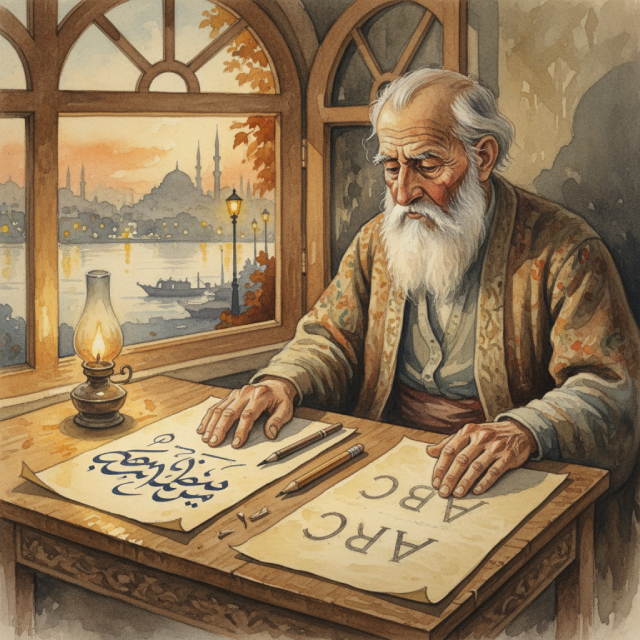
Istanbul, November 1928
Khalil’s ink no longer dried as it used to.
Seated at his small walnut table, near the window overlooking the Golden Horn, he traced the same letters he had learned at the age of seven in the courtyard of the Süleymaniye Mosque: elif, be, te… The elegant curves of the Ottoman alphabet, those hieroglyphs of faith and empire that he had served for forty years as a scribe at the Fatih court. But that morning, the ink flowed too quickly, smearing on the blotting paper. As if it refused to adhere to doomed symbols.
The day before, the Cumhur had published the decree: as of November 1st, the Latin alphabet would replace Arabic for writing Turkish. A law signed by Mustafa Kemal himself. In the streets, impromptu teachers set up blackboards under the plane trees, tracing a, b, c as if raising a new flag. The children laughed as they learned these angular shapes, these "naked" letters stripped of the diacritical marks that, in the old system, distinguished be from te from se.
Khalil had seen his first customer of the day—a young merchant from the Grand Bazaar—leave with his will written in Ottoman Turkish, then return two hours later, his brow furrowed:
"Hodja Efendi, the notary, is refusing this document. He says it has to be in yeni harfler… the new letters."
The young man had placed a school notebook on the table, where foreign characters danced: Cumhur became Cumhuriyet, İstanbul was now written with an I without a dot. Khalil had caressed the paper with his fingertips. It was like seeing his mother's name written in a foreign language.
At midday, a little girl knocked on his door. Twelve-year-old Leyla, her hair cut short according to the republican fashion, wore the blue uniform of the public schools. She held a new textbook: Elifbe Kitabı, the first Latin primer.
“My father says you can help me, hodja. I need to learn to read our family’s old records.” Khalil hesitated. Then he opened a cedar chest and took out a birth register dating from 1890. He showed Leyla how to decipher the ligatures, how to recognize the final kef that stretches out like a prayer. The girl listened attentively, but her fingers nervously flicked her pencil—that modern object that required neither reed pen nor patience.
“And why do you want to read these old papers?” Khalil asked.
“Because they tell the story of my great-grandfather.” He was a fisherman in Üsküdar. His name is written here, isn't it?'
Khalil found the name. Yusuf oğlu Mehmet. In Arabic script, oğlu—"son of"—blended into the sentence like a root in the earth. In Latin, it would now be oğlu, visible, isolated. The genealogical link suddenly became clearer, colder.
One rainy evening, Khalil walked to the Kültür café, near Taksim Square. There, young people were debating heatedly about the virtues of the Latin alphabet: "The old system was a trap!" shouted a student. "Thirty-four letters for sounds that don't even exist in Turkish! Arabic tied us to a past that wasn't ours!"
Khalil drank his tea in silence. He thought of the manuscripts in Topkapi Palace that he had copied in his youth—the divans of Persian poetry, the sultanic firmans where each word was a miniature. He also thought of the illiterate peasants of central Anatolia who, in thirty years, had never learned to read Arabic… and who now, it was said, would master writing in a few months.
On his way home, he passed a group of men his own age, former scribes like himself, sitting on the steps of a disused fountain. They were smoking in silence, their broken reed pens resting at their feet like surrendered swords. One of them murmured, “We were the guardians of the words. Now, any child with a pencil can write a letter.”
Khalil didn’t reply. He watched the rain wash the cobblestones, erase the footprints—just as the new alphabet, without anger or hatred, erased an entire way of being in the world.
The next day, he didn't put away his inkwell. He took a new notebook, opened Leyla's textbook, and began to trace clumsily Latin letters. A. B. C. His fingers trembled. But at the bottom of the page, he wrote a sentence in both alphabets, side by side:
Eski kelimeler kalplerde yaşar. (Old words live in hearts.)
Then he went to find Leyla. He would teach her the old alphabet—not like a jealous guardian of a treasure, but like a ferryman. And she, in return, would teach him the new letters. Not to forget, but so that words, whatever their guise, would continue to carry the voices of those who were no more.
Outside, the muezzin chanted the call to prayer. Soon, even that call would be broadcast over loudspeakers—another voice shedding its skin. But for now, only the human voice rose to the heavens, untouched, traversing the ages without needing letters to exist.
Note historique:
The alphabet reform, promulgated on November 1, 1928, was part of the Kemalist modernization reforms. The Ottoman alphabet, derived from Arabic, had 34 letters but did not accurately represent Turkish vowels. The adopted Latin alphabet had 29 letters specifically adapted to Turkish. Traditional scribes (katip) and learned religious figures (hodja) effectively lost their social monopoly; mass literacy campaigns were launched as early as 1929. The word "hodja" (hoca) referred to both the religious teacher and the scholar—a title that became obsolete with the secularization of education.



