The Horn
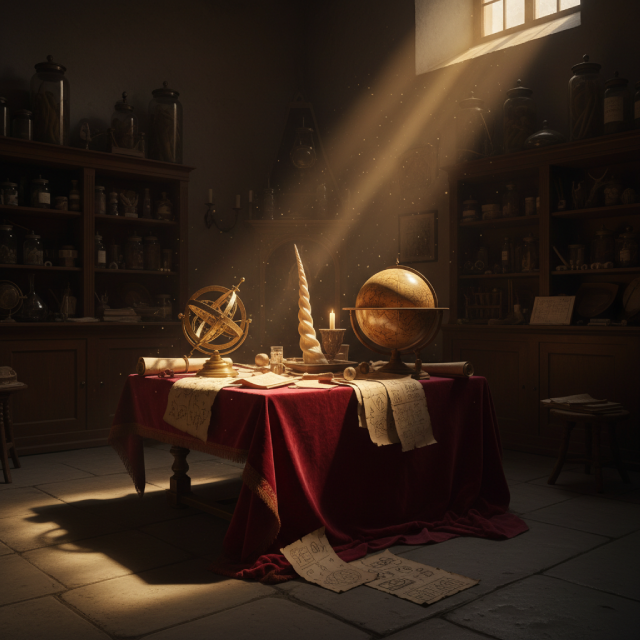
Prague, winter 1605
There is a particular dust that settles only in this room. Not grey like the dust of roads, nor black like the dust of chimneys. It is golden, made of particles of varnished wood, of crushed pigments, and of time reduced to powder. It dances in the shaft of light that passes through the western stained-glass window, at the precise moment when the day begins to surrender to the night.
That is where it rests. The Horn.
It lies on a red velvet cloth, worn by the years, darker than blood. It measures nearly three cubits in length, a perfect spiral, ivory yellowing toward the base, milky white toward the tip. They say it cures poisons. They say it purifies water. They say it belongs to a beast that does not exist.
I am the Keeper of Keys. I am the one who dusts, who adjusts the cushions, who checks the moisture of the air. I am the one who knows.
I know this horn came from a Greenlandic fisherman. I know it is the tooth of a narwhal, torn from a creature of the ice that never once set foot on dry land. I know it is not worth a third of what the Emperor paid for it.
But I also know that truth is a fragile thing, which shatters faster than Venetian glass.
The door opened without a sound. I did not turn around. I knew his gait: a heavy gliding, as though his boots carried the weight of every province in the Empire. Rudolph entered. He wore no crown. His hair was long, greying, falling over a lace collar that seemed too tight for his throat.
He did not greet me. He never greeted objects, nor those who served them. He approached the table. The evening light struck his aquiline profile, deepening the shadows beneath his eyes. He had the gaze of one who has read too much, seen too much, and seeks now only to remember.
He reached out his hand. His fingers trembled slightly — a trembling he concealed from ambassadors, but not from objects. He brushed the spiral of the horn.
— It is cold, he said.
His voice was hoarse, little used.
— Marble is cold too, Sire, I replied. It does not prevent the statues from weeping.
He did not smile. He turned the horn upon itself. The light played across the ivory grooves.
— Matthias arrived this morning, he said. He speaks of Vienna. He speaks of troops. He speaks of raison d'État.
He paused. His hand came to rest at the tip of the horn, dangerously close to drawing blood.
— Do you believe, Keeper, that it would purify the poisoned wine of politics?
I chose my words with the care of a jeweller setting a loose stone.
— It purifies what you believe it purifies, Sire.
Rudolph withdrew his hand. He turned toward the window. Outside, Prague was lighting up. The bells were ringing vespers. The world went on, indifferent to the melancholy of its Emperor.
— When I was a child, in Spain, I was taught that the world was a book written by God. Every thing had a meaning. The lion was strength, the lamb was gentleness, the unicorn was purity.
He turned to face me. In the half-darkness, his face was a wax mask.
— Today, Kepler shows me orbits that are not perfect circles. He tells me the Earth revolves around the Sun, and not the reverse. He tells me the sky is a mechanism, not a mystery.
He came back to the table. He placed both hands flat upon it, on either side of the horn, as though to protect it — or to protect himself from it.
— If I were to tell you that I know... If I were to tell you that I know it is a fish's tooth... What would you think of me?
I inclined my head slightly. The respect owed to power, and also the pity owed to the man.
— I would think that you are the only free man in this room, Sire.
He looked at me, surprised. A glimmer passed through his eyes, swiftly extinguished.
— Free?
— The others believe in the legend because they need magic to endure their lives. You keep the legend because you need beauty to endure the truth.
Rudolph remained silent for a long while. The sun had gone. The room was lit now only by the dying glow of the stained-glass window and the candle I had just lit on the desk. The shadow of the horn stretched long across the wall, outsized, becoming truly a unicorn in the darkness.
— Leave me, he said at last.
I bowed. I stepped back toward the door.
— Sire... the candle?
— Leave it. I want to watch it burn down.
I left. I closed the door. On the other side, I knew he remained standing, motionless, watching the flame struggle against the dark, one hand resting on a false horn, in an empire that was nothing more than a memory.
I am the Keeper of Keys. I keep the secrets of objects. But the greatest secret is not held within the horn.
The secret is that Rudolph II did not believe in the unicorn. He believed only that he needed it.
And in the silence of the castle, as the candle wept its warm wax, the Emperor and the imaginary beast kept each other company — two exiles waiting for the end of the world.



