Isabel Barreto, Admiral of the South Seas
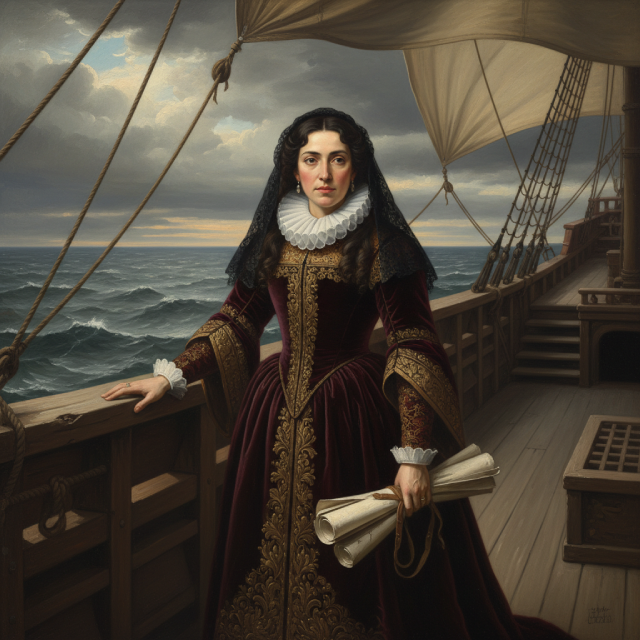
I. The Woman Who Knew How to Count
In 1595, when the expedition of Álvaro de Mendaña de Neira left the port of Callao with four ships and some four hundred souls on board, no one paid much attention to Isabel Barreto. She was the expedition leader's wife, which made her a tolerated presence rather than a truly noticed one — the way one tolerates a cat on a ship, for the mice and the company. She was beautiful, they say, and from a respectable family in Galicia. That much was granted to her.
What was less remarked upon, or refused to be seen, was that she kept the accounts. Not as a whim or to fill her days of rolling seas, but because she had a sharp sense of arithmetic and a memory for figures that sometimes embarrassed her husband. She knew how many barrels of flour remained in the hold, to the last piece. She knew the names of every indebted sailor. She had read the navigation charts with the same attention she had given to the property deeds her father had taught her to decipher as a child.
The expedition's aim was ambitious: to find the Solomon Islands, which Mendaña had glimpsed on a previous voyage in 1568, and to establish a Spanish colony there. The enterprise had the blessing of the Viceroy of Peru and the vague hopes of a southern continent rich in gold — that continent whose European geographers populated their maps with a generosity inversely proportional to their actual knowledge of the places.
From the first weeks, the navigators quarrelled over the route. The crossing was long, the heat exhausting, and the men, as is customary at sea, discovered within themselves resentments they had not suspected on land. Isabel observed. She did not speak much. She counted.
The Solomon Islands were not where Mendaña had left them — or at least, that is what the ocean seemed to suggest. It is not easy to lose an archipelago, but the Pacific is vast, and sixteenth-century navigation rested on calculations that the sea did not always take the trouble to validate. The expedition eventually reached the Marquesas Islands, which it named as such, then the Santa Cruz Islands, which were neither the Solomons nor the earthly paradise.
II. Widowhood and Its Complications
Mendaña died in October 1595, at the Santa Cruz Islands, of a fever that would not end. The colony he was trying to found died with him — the land was hostile, relations with the local inhabitants had turned to massacre, and the Spanish colonists, who had crossed an ocean in search of abundance, were dying of dysentery in makeshift huts.
It was at this moment that Isabel Barreto revealed a side of her character that no one, apparently, had anticipated. She took command.
The thing was without precedent. Not that women of character did not exist in Spain and its colonies — they existed in great numbers — but command of a fleet in the middle of the South Sea was another matter entirely. The officers present, beginning with the pilot Pedro Fernández de Quirós, looked at the widow with an expression that the testimonies of the time do not transcribe explicitly but which one can easily imagine. It was the expression of someone who finds himself in a situation that his mental categories do not yet allow him to name.
Isabel did not give them time to find the words. She summoned the remaining captains, laid out the situation with a clarity that did not invite discussion, and announced that the ships would set course for Manila. She signed the command documents in her own hand. She was henceforth, in fact if not yet entirely in law, General of the South Sea.
The crossing that followed was a calvary. Men were dying. Provisions were running out. The ships were in poor condition. On board, certain officers murmured; Isabel had those who murmured too loudly put in irons. She was not an easy woman. But the ships moved forward.
III. Manila, and After
They reached Manila in February 1596. The reception was courteous but tense: no one quite knew how to treat a woman who presented herself as expedition leader and claimed accordingly the respect due to that title. The Governor of the Philippines stalled, temporised, searched for a legal angle to get around the situation. Isabel, who had crossed the Pacific with men dying around her, was not intimidated by colonial paperwork.
She got her way on the essentials, then departed. She remarried quickly — a certain Fernando de Castro, acting governor, a practical man who no doubt understood that Mendaña's widow was a more complex proposition than expected, yet one who nonetheless owned land in Peru and held a title worth something. The marriage was, by all accounts, satisfactory to both parties.
The Spanish Crown eventually acknowledged her merits and granted her the title of Almirante — Admiral — of the South Seas. It was an honorary title, which meant that what she had accomplished was recognised while ensuring she would not repeat it under that precise title. Institutions have their ways of paying tribute that sometimes resemble keeping a safe distance.
Isabel Barreto then disappears from the archives with the discretion of those who have nothing left to prove. She is lost somewhere between Lima and Spain, around the early years of the seventeenth century. She was then between forty and fifty years old depending on the source, which made her, for the time, a woman of respectable age.
IV. What the Islands Keep
Little direct documentation remains of her. A few signatures. Mentions in the logbooks of other navigators — Quirós speaks of her with a carefully maintained ambivalence, the way one speaks of an experience from which one has not entirely recovered. Notarial deeds in Lima. And the title, that title of Almirante that no other woman had borne before her in the history of Spanish navigation.
One might be surprised that history ignored her for so long. But history has its habits, and women who command fleets enter it with difficulty — not because they lack substance, but because the categories into which great figures are sorted have been cut for centuries to a particular measure, and sometimes one must wait for the fabric to stretch.
What is certain is that in 1596, somewhere in the Pacific, on a ship taking on water with men dying around her, a woman from Galicia set course for Manila, kept her registers up to date, and brought back what could still be saved. She had not found the Solomon Islands. She had found something else — something that the cartography of the time had no box to record: proof that a command held with rigour has no sex, even if the archives take their time admitting it.
The Marquesas Islands still carry her memory indirectly — they were named in honour of the Marquis of Cañete, the Viceroy who had financed the expedition, which is the customary way in which history assigns honours. But someone was there to see those islands, to note them down, to survive the return. That someone had eyes that counted with precision and a hand that knew how to sign an order.



