Purple in the Dust
Edessa, August 260 AD
My name is Titus Aurelius Marcellus, and I watched a god shatter.
Not in a temple. Not beneath the thunder of an offended sky. On a Mesopotamian plain, between two rivers that the gods themselves seem to have forgotten, under a sun that forgives nothing.
I was twenty-two years old when I was assigned to the Emperor's personal guard. A favor, said my centurion, his throat swelling with a pride that wasn't mine to own. A favor. As though proximity to power were a gift rather than a curse.
The campaign had begun badly. We all knew it, but no one said so — that is how armies work: the truth travels in whispers through the ranks, then vanishes the moment the trumpet sounds. Money was short. The Rhine legions had been demanding their pay for months. And in the corridors of the palace, people still murmured the name of Gordian III — that thirteen-year-old boy dressed up as a general and led to his death, a few years earlier, against this same Persian enemy.
Valerian, for his part, was no boy. He was well past sixty, his back straight, his gaze that of a man who had survived decades of senatorial treachery. But sixty is sixty. And Shapur I was not a man impressed by age.
They called Shapur Shahanshah — King of Kings. I had heard that title a hundred times without giving it much thought. Easterners liked grand titles; Rome did too, for that matter. But when I first saw the Sassanid standards on the horizon, their fires of infantry and cavalry stretching for leagues across the plain like a glowing wound, I understood that this particular title was no vanity. It was a warning.
The Battle of Edessa lasted less time than it takes to recount.
We were already exhausted before it began. Dysentery had decimated two entire cohorts in the preceding weeks — men lying in their own filth, far from any glory. The supply convoys had stopped coming. We had eaten the pack horses. And Shapur had waited. Patiently. Like a hawk observing from the heights the beast that is about to die.
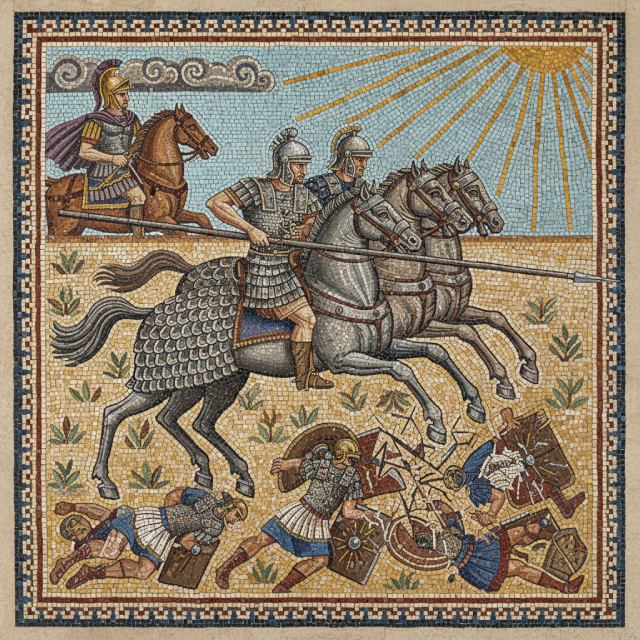
When his cataphract cavalry swept down upon our left flank — those riders entirely encased in armor, their horses sheathed in iron as much as their riders — I had time to think one absurd thought: they are beautiful.
That terrible beauty of things that are about to destroy you.
The line held for an hour. Then it broke.
I remember a detail I cannot erase from my memory: the moment I understood that all was lost did not come from the chaos of battle. It came from the sudden, inexplicable silence that fell around the Augustus.
The guards were falling back. Not in rout — in calculated retreat, their eyes fixed on Valerian as though their sole purpose was to shield him from an enemy already everywhere. And he sat motionless on his horse, his left hand resting on the pommel of a sword he would never draw again.
His face was that of a man who understands.
Not fear. Understanding. That cold and final lucidity of a man who realizes that something irreparable has just occurred — that history, in this precise instant, is changing course forever.
Shapur's horsemen encircled him in silence. Almost ceremonially.
They did not kill us, the guard. We were bound and pushed into a column, eastward, toward the rising sun. I walked for weeks. I saw cities whose names I did not know. I crossed deserts that existed in none of my dreams.
And before me, always, flanked by Persian soldiers in gilded armor, the man who wore the purple of Rome walked on foot through the dust of Mesopotamia.
Valerian. Emperor of the Romans. Prisoner of Shapur I.
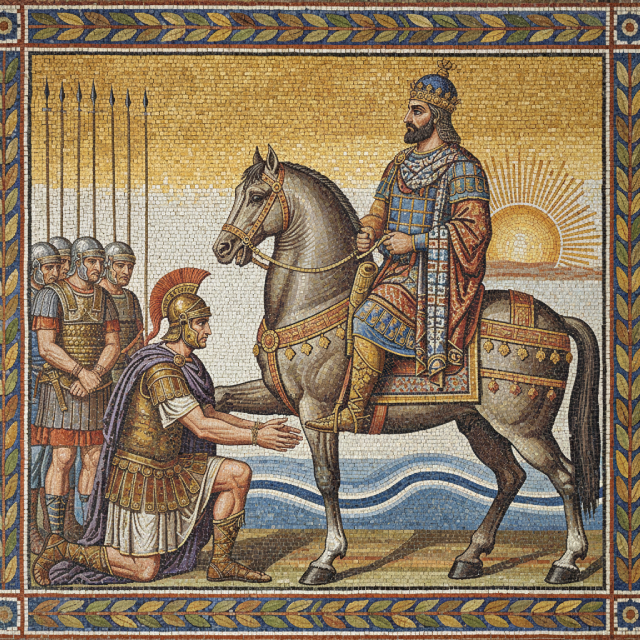
It is said that Shapur had this scene carved into the rock at Naqsh-e Rostam, where the Achaemenid kings lie at rest. An inscription for eternity: the Augustus of Rome kneeling, his hands outstretched in submission, while the King of Kings towers over him on horseback.
I did not see that carving. But I have no need of it.
I saw the real thing.