The Rose of the Dead
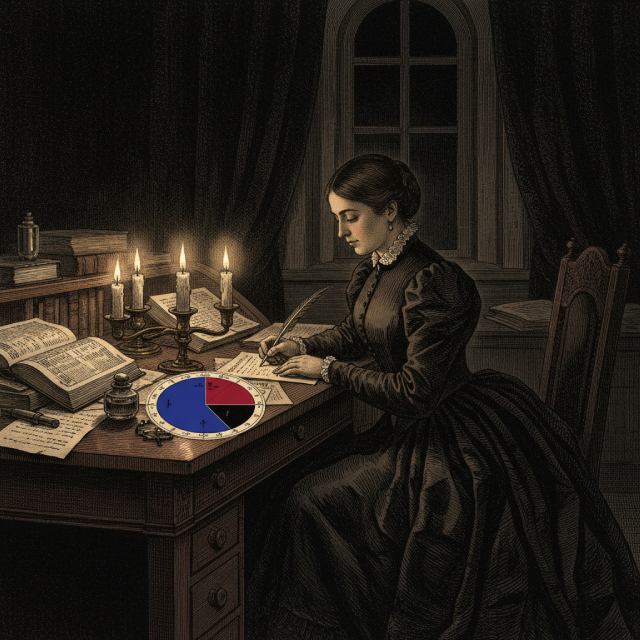
She grew up in a house where women knew how to embroider, play the piano, and wait. Florence Nightingale also knew how to calculate. At sixteen, she asked her father for permission to study mathematics with a tutor. He refused. She insisted. He relented — reluctantly, the way one gives a wilful child something useless, convinced it would lead nowhere.
It led to the Crimea.
In 1854, when she arrived at Scutari with thirty-eight nurses, the British military hospital was a methodical dying place. The soldiers did not die there from wounds received in battle — they died of dysentery, typhus, cholera. They died from the contaminated water running beneath the rotting floorboards. They died from the fouled air of overcrowded wards where corpses waited too long to be removed. The mortality rate exceeded forty percent. The surgeons accepted it. This is war, they said. Men die.
Florence Nightingale looked, and what she saw, she counted.
She spent her nights moving through the corridors with her lamp — that lamp which would make her an icon, a madonna of mercy, a devotional image that Victorian England could hang on the wall of its conscience. But while journalists sketched the saint at the bedside of the dying, she kept registers. She recorded causes of death, dates, sanitary conditions, quantities of food, the source of the water. She transformed horror into columns of figures because she had understood something most of her contemporaries had not yet grasped: power is not convinced by tears. It is convinced by evidence.
When she returned to England in 1856, wreathed in a glory she had not sought and did not trust, she was the most famous woman in the kingdom after the Queen. Crowds welcomed her. Poems circulated. People named babies after her, racehorses, steamships. She did not care. She had forty thousand words to write.
What she produced was an eight-hundred-page report on the health of the British army. No one would read it. She knew this. Which is why she invented something else.
The diagram she designed in 1858 had no established name at the time — it would later be called the "rose diagram" or "coxcomb," and statisticians would recognise it as one of the earliest modern examples of data visualisation.
She saw it as a tool. The circle was divided into twelve sectors, one for each month. Each sector extended outward in three colours: blue for preventable diseases, red for battle wounds, black for other causes. The blue overwhelmed everything. The blue was monstrous. The blue said, without a word, without a tear, what columns of figures could never say to a busy minister or an impatient general: your men are not dying in combat. They are dying from your neglect.
She had the diagram printed in colour. She sent it to Queen Victoria, to the Secretary of State for War, to Members of Parliament, to journalists, to influential physicians. She accompanied each copy with a personal letter, calibrated for its recipient — flattering with some, technical with others, imperious with those she knew responded to authority. She had studied each man, his vanities, his blind spots, the arguments he could hear and those that would shut him tight as an oyster. This politics — meticulous and invisible — was her real work.
For Florence Nightingale could not enter a parliamentary committee room. She could not testify before Parliament. She could not vote, stand for any office, or sign an official report with a signature that would carry weight. She had to find men who would carry her ideas as though they were their own — and she found them. Sidney Herbert, Secretary of State for War, became her right hand, or rather she became his directing mind. She wrote his speeches. She prepared his arguments. She drafted the questions he would ask during hearings, then the answers he should give. He stood at the front of the stage; she was in the room she had now made her permanent home in London, surrounded by papers and figures, worn down by an illness contracted in the Crimea that would never leave her.
That illness has long been debated. Perhaps brucellosis, perhaps something else — a chronic fever that exhausted her, confined her to bed for weeks at a time, forbade her travel and social engagements. Some historians have suggested, with a condescension that speaks volumes, that it may have been psychosomatic. What those historians neglect to mention is that bedridden, invalid, and supposedly dying, she reformed the sanitary system of the British army, founded the nursing school at St Thomas' Hospital, wrote reports on sanitary conditions in India without ever setting foot there, shaped hospital design on three continents, and corresponded with Bismarck.
She died in 1910, aged ninety.
What history remembered about her was the lamp. The gentle woman who watched over soldiers in the night. The angel of the Crimea. It was the image she would most gladly have shattered — this woman who knew that sentimentality was the enemy of action, that pity without method saved no one, and that a well-drawn rose could accomplish what no prayer had ever managed: compel the living to look at the dead, and to count.



