The Priory of Utrecht
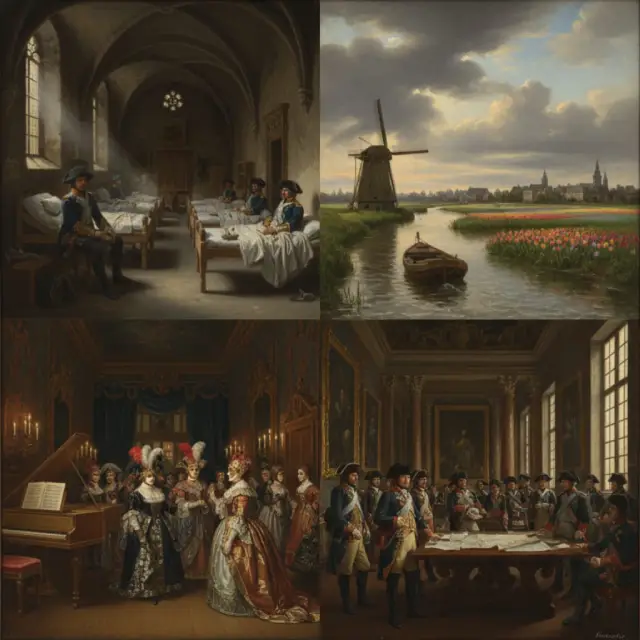
The north wind swept across the fields of tulips when Fabriek van den Dijk first met Claudine’s gaze. It was at Professor van der Veen’s house, in a salon where Kant was debated between glasses of genever. She had eyes as blue as the IJssel lake, and when she took a seat at the piano to play Mozart, Fabriek knew he had just lost something he would never regain.
The younger son of a conservative baron, a law student without conviction, he was searching for a cause that could give his life meaning. The French Revolution was setting minds ablaze in Amsterdam, but it was Claudine—daughter of a diamond merchant—who lit the fire in his own.
“Are you enlisting?” she asked when he told her he intended to join the Queen’s Guard.
“For the Batavian Republic.”
“To flee your father, perhaps.”
She was right, as always. Yet she did not yet know that in 1799 the Republic would collapse, that political chaos would open chasms into which ambitious youths could either fall or rise.
The Priory.
A Prussian bullet pierced him at Kleve—not a glorious wound, just a broken leg that sent him crawling back to the priory of Utrecht, now turned into a military hospital. The scent of blood and laudanum saturated the medieval vaults. In a place once devoted to prayer, prayers were now offered only for morphine.
It was there that he saw her again.
Claudine wore a stained apron; hands that had once brushed ivory keys now cleaned suppurating wounds. She recognized him, but did not smile.
“You’re here, Count van den Dijk,” she said.
“I am not a count.”
“Not yet.”
Monsieur De Groot, the commander of the priory, hid a secret that Fabriek discovered by accident: he was protecting Marta, Claudine’s sister, who had been forced into marriage with an Austrian noble and was now on the run. In the corridors of the priory, among the dying beds, alliances were forged that were sturdier than those sealed in palaces.
The Masquerade Ball.
When Prince Frederik appointed him to his personal guard, Fabriek realized he had entered a game whose rules he did not control. Duke Hendrik van Oranje, the king’s cousin, was plotting a coup. The prince was to die at the masquerade ball held at the King’s House in The Hague.
Candles flickered, Venetian masks concealed faces but not intentions. Disguised as a knight, Fabriek spotted the duke on the staircase, weapon in hand. He had no time to think—his sword sang before his conscience could speak.
The duel was brief, brutal. The duke collapsed in a rustle of silk and blood.
In the ensuing confusion, a chandelier gave way. Claudine, waiting for him in the garden, was struck by falling crystal and metal as if by divine judgment. She survived, her left side paralysed—a punishment for loving a man who played with history.
The prince made him a count. Fabriek would have preferred that Claudine still be able to walk.
Leiden.
The years that followed were ones of reform: abolition of privileges, a parliamentary constitution, free schools. Prince Frederik built a new nation upon the ruins of the old. But the conservatives did not disarm.
In Leiden, where Fabriek commanded the garrison, Marta came to find him. She had fled her husband and was hiding near the canal. She told him of a plot to destroy the Rijn bridge, to starve the capital and restore feudal order.
Fabriek foiled the scheme, captured Count van der Meer. The grateful prince offered him the post of Minister of Defence and Marta’s hand—a political alliance, certainly, but also redemption. He had saved his sister after, in a way, destroying Claudine.
The Shadow of the Mill.
Years later, from the terrace of his manor in Delft, Fabriek watched the windmills turning beneath a grey sky. His children played in the garden. Marta stitched by the window. Peace, at last.
Claudine had never stopped writing. Her letters and poems, published under the name The Shadow of the Mill, circulated throughout Europe. She wrote of Dutch landscapes, of the low‑angled light over the canals, of the price of liberty. She never mentioned the masquerade ball, the chandelier, or the love she bore for a man who chose history over her.
Fabriek now understood that true heroism lay not in battles, but in the ability to live with one’s choices—to build bridges between peoples after having burned the ones that once linked hearts.
When he died, at sixty‑eight, historians turned him into legend. Yet in the secret archives of the Priory of Utrecht, guarded by monks who had never truly left the place, a letter from Claudine—never sent—was found:
“You saved a prince and lost a woman. History will remember your name. I have retained only your face that night, at Professor van der Veen’s house, when you listened to me play Mozart as if music could stop time. It could not. Nothing can.”



