The Dance of Frau Troffea
What exactly happened remains a mystery.
Strasbourg, July 1518
On the first day, people thought it was a nervous breakdown.
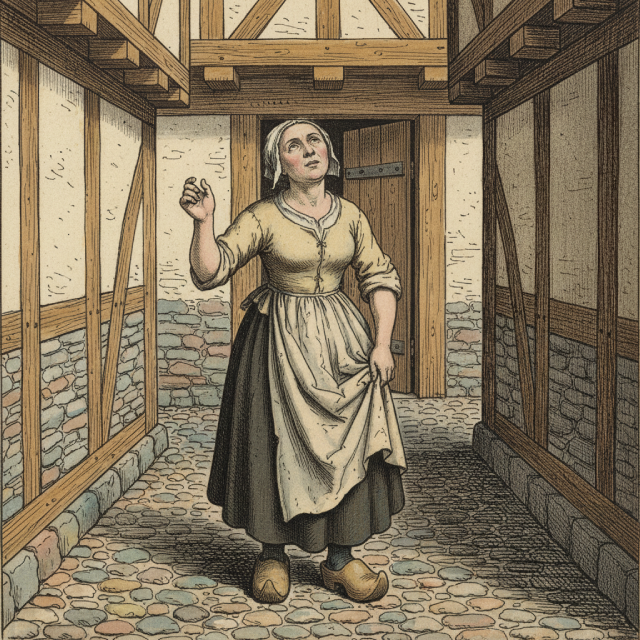
Frau Troffea had stepped out of her house in the early morning, into the narrow alley running alongside the tanners' quarter, and she had begun to dance. No one was playing music. There was no celebration, no occasion, not even a drunkard to applaud her. She danced alone, in silence, with an expression her neighbours took some time to name correctly: it was not joy. It was not pain, either. It was something in between and incomprehensible, as though her body had reached a decision without consulting her soul.
Her husband called to her. She did not stop.
The day passed. Evening fell over the city. Frau Troffea was still dancing, her feet bleeding in her clogs, her arms tracing figures in the warm air that no one could recognize. Children had gathered to watch, then grown bored. Adults had shrugged and gone in for supper. Her husband had sat on the doorstep and watched her with the look of a man who does not understand but has stopped wondering why.
The next morning, she was still dancing.
A week later, there were thirty of them.
The thing had spread without apparent logic — not like a rumour or a fashion, but like something that had been sleeping inside bodies and woke at the touch of an invisible trigger. A woman had seen Frau Troffea from her window and, three days later, she too was dancing in her street. A man had joined her. Then an old woman, then a teenager, then another woman still holding in her hand the bread she had been carrying to the oven.
The authorities of Strasbourg — the municipal Council, the aldermen, the pragmatic men who administered one of the most prosperous cities in the Holy Roman Empire — convened in emergency session. They were men of the sixteenth century, which is to say they possessed simultaneously a great practical intelligence and conceptual frameworks that would strike us today as fabulous. After deliberation, they concluded that the dancing was a disease of the blood. An excess of hot humours. And that the logical remedy was to let the affliction exhaust itself. Better yet: the process would be assisted by engaging professional musicians to accompany the dancers. Music, they reasoned, would allow the bodies to find their rhythm and naturally calm themselves.
Stages were erected. Fife and drum players were hired. Guards were even assigned to ensure no one strayed too far, so that the dancers might remain together — watched, accompanied.
It was perhaps the most catastrophically reasonable decision in Strasbourg's municipal history.
At its peak, in August, there were more than four hundred.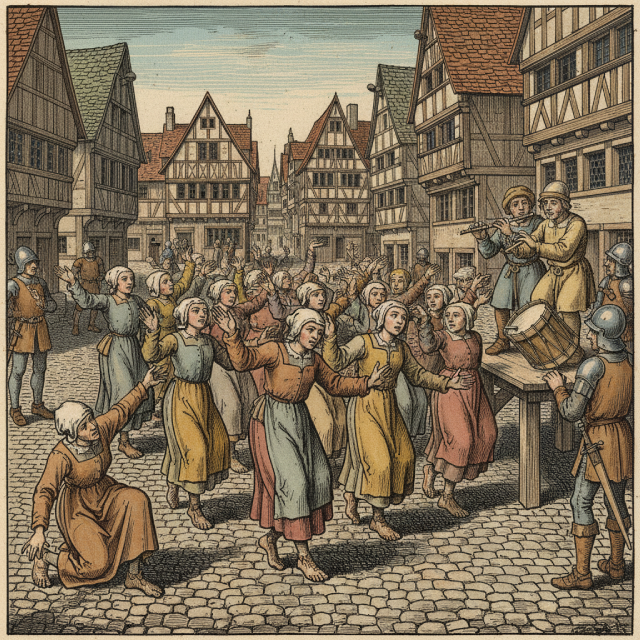
The square where the dancers had been gathered resembled a vision of Bosch's hell — but a silent, methodical, almost bureaucratic hell. The musicians played without pause, in shifts, replaced when they collapsed from exhaustion. The dancers did not stop to eat, barely to drink. Some fainted and resumed their movement upon coming to, as though something within them refused the truce their flesh was begging for.
The first deaths came quickly. Heart failure, for the most part. Exhausted hearts that had simply stopped beating after days of unrelenting contraction. They were carried away discreetly. The others continued.
The chroniclers of the time, whose accounts can still be read today in the city's archives, noted with care the names, the dates, the details. Sebastian Brant, a Strasbourg humanist, wrote that the city was suffering a divine punishment. The physician Hieronymus Gebwiler sought astrological explanations. The Council, overtaken by the reality of its stages and its musicians playing for the dying, eventually changed course: music was banned, the stages dismantled, the dancers transported to shrines dedicated to Saint Vitus — whose intercession was traditionally invoked for convulsive ailments.
Towards the end of August, it stopped. As mysteriously as it had begun.
What exactly happened in Strasbourg during that summer of 1518 remains, five centuries on, an open question.
The most robust hypothesis today is that of mass hysteria — or, to use the contemporary medical term, a collective dissociative disorder. Strasbourg was at the time enduring famine, recurring epidemics of syphilis and plague, and the religious tensions that would prefigure the Reformation breaking out two years later. The city's inhabitants were living in a state of chronic stress and anguish that nothing in their conceptual framework allowed them to name or address. The body, in certain extreme circumstances, finds its own outlets. The dancing — uncontrolled, frenetic, contagious — would have been the somatic expression of a collective suffering that could find no other form.
Others have proposed ergotism: a fungal parasite of rye, Claviceps purpura, whose alkaloids can cause convulsions and hallucinations. The summer had been poor for harvests, rye bread was the staple of the popular diet. It is possible. But ergotism is not transmitted through observation, and the geographic progression of the dancing followed social ties more closely than food sources.
Still others, a minority, have raised the possibility of food toxins or environmental factors we do not yet know how to identify.
The truth is that we do not know.
What we do know is that Frau Troffea danced in her alley for six days before anyone understood that something extraordinary was unfolding. That the authorities of Strasbourg, with the best intentions in the world, made the situation worse by giving it an official framework and musicians. That people died of dancing in a European city, one summer in the sixteenth century, and that their names are recorded in archives that can still be consulted.
And that the human body, collectively, remains capable of things that reason struggles to contain.



