The Transparency of Power
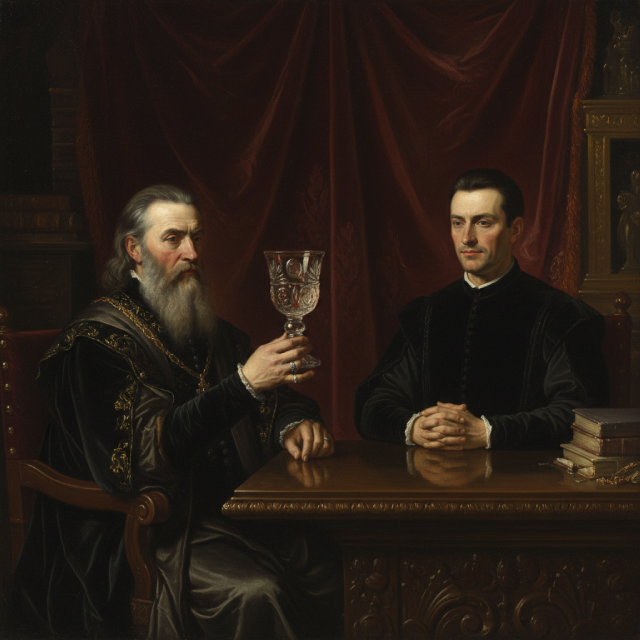
The "polite violence" aspect is historically accurate: Rudolf's deposition was achieved through treaties, without open warfare between the two brothers.
Prague, 1608.
The room was hung with black velvet, but on the oak table there was only one object: a rock crystal cup, cut from a single block, so pure it seemed to contain light rather than wine.
Rudolf II held the cup in his hands. He turned it slowly, watching how the candlelight shattered into a thousand splinters within the transparent stone. It was one of the treasures of his cabinet, a marvel that ambassadors came to see from across Europe.
Opposite him, his brother Matthias waited. He was not looking at the cup. He was looking at the Emperor.
There were no guards. No shouting. No threats. Just two middle-aged men sitting at a table, in the hushed silence of a palace that still belonged to one of them, but already belonged to the other.
— The wine is excellent, said Matthias. Is it a Tokaji? — A Bohemian wine, Rudolf replied without raising his eyes. You will not be staying to drink any more of it.
Matthias smiled. A polite, administrative smile. — We must speak of Austria, Rudolf. And of Hungary. The estates have expressed their concerns. — My estates. — Our estates, Matthias corrected gently. But the time has come for me to take over. For the good of the family. For the good of the Empire.
Rudolf set the cup down on the table. The crystal rang against the wood, a pure sound that echoed through the empty room.
— You have come to steal my lands, Matthias. And you speak as though you are doing me a favour. — I am stealing nothing. I am taking what you can no longer govern. Look at yourself. When did you last receive an ambassador? When did you last sign a decree that was not inspired by your astrologers?
Matthias's voice remained calm. That was the most terrible thing of all. There was no anger. No brotherly hatred. Only a plain assessment, delivered with the precision of a notary drawing up an inventory after a death.
— I am still Emperor, said Rudolf. — You are. But Austria and Hungary need a governor who is present. I will be that governor. You will keep the title. You will keep Prague. You will keep —
Matthias made a sweeping gesture, encompassing the cabinet of curiosities.
— ... your wonders.
Rudolf understood then the nature of this violence. Power was not being torn from him in a bloodbath. It was being removed from him the way a toy is taken from a wilful child: with patience, with condescension, with a murderous courtesy.
He picked up the crystal cup again. Through the transparent stone, he saw his own hand, distorted and trembling. He saw the world upside down.
— And Bohemia? he asked. — For now, Bohemia remains yours. But we shall speak of it again.
We shall speak of it again. Three words. A political death sentence, pronounced without raising one's voice.
Matthias rose. He adjusted his doublet, smoothed his moustache. He was already the sovereign in his bearing, while Rudolf remained slumped in his armchair — an old man holding an empty glass.
— I shall have the documents drawn up for the cession of Austria and Hungary. Formalities, you understand. Everything must be in order. — Formalities, Rudolf repeated.
Matthias inclined his head slightly — a respectful gesture that was the final insult. Then he turned on his heel and left the room. His footsteps receded down the corridor, steady and unhurried. The sound of a man who knows where he is going.
Rudolf remained alone. He raised the cup toward the light. The crystal was perfect, flawless, without fault. It could hold wine, or poison, or emptiness. It amounted to the same thing.
He understood then that Matthias had been right about one thing: it was merely a formality. Power did not reside in this cup. It did not reside in titles. It resided in the ability to rise and walk toward the door with assurance. And that, Rudolf could no longer do.
He set the cup down. The crystal did not shatter. It remained intact, transparent, a silent witness to an abdication that dared not speak its name. The most absolute violence had no need of blood. A glass, a signature, and a brother who takes the world from you with the courtesy of a man returning a borrowed book — that was quite enough.
(Rudolf II was indeed a passionate collector of rock crystal. His cabinet of curiosities contained some of the finest pieces ever cut. These objects were considered more precious than gold. Several of these pieces are now housed in the Kunsthistorisches Museum in Vienna.)



