The Witch Famine

Languedoc, autumn 1682
Master Anselme Pouget had a nose for things. That was the foundation of his reputation, and the foundation, likewise, of his income. For sniffing out a witch is not a skill one improvises: it requires years of training, a particular sensitivity to certain signs — a gaze too direct, a kitchen garden too prosperous, a cow in suspiciously good health — and above all, a total moral selflessness that allows one to denounce one's neighbour without the hand trembling.
Anselme had thus, over twenty years of diligent practice, sniffed out eleven witches. Two millers' wives, an herbalist, three widows of modest means (the most suspect, as they lived alone and had no one to defend them), a midwife whose deliveries succeeded too often to be honest, and four others whose names he had since forgotten but whose inheritances had left him with a precise and lasting impression.
He did not consider himself a greedy man. He considered himself a useful one.
It was therefore with entirely legitimate anxiety that he learned, in the autumn of 1682, of the royal edict. His Majesty Louis XIV, King of France and Navarre, in his great wisdom, had decreed that the goods of those condemned for witchcraft would henceforth pass not to the informer, but to the Royal Treasury.
Anselme read the document three times.
Then he sat down.
He looked out the window at the Widow Matheron's kitchen garden, which was, it must be said, scandalously fertile for the season. He waited for something to stir within him — the righteous indignation that had always set him in motion, that civic flame which had guided him to the tribunals so many times.
Nothing.
A strange interior silence.
He folded the edict and went to bed.
Weeks passed. Then months. In Montpellier, the prosecutor Daubin — who had handled eight of Anselme's eleven cases with remarkable zeal and reasonable fees — began to notice an alarming drop in reports. In Nîmes, the same. In Béziers, Judge Sarrasin received a denunciation in November: he examined it, summoned the alleged witch — a sixty-year-old woman who smelled of lavender and treated sprains with lard — and, seized by an inexplicable weariness, filed the matter away.
What would be the point, he thought vaguely, without quite following the thought to its conclusion.
In the countryside, neighbours regarded one another differently. Not with greater kindness — that would not have been in keeping with the habits of the region — but with a new sort of indifference, as though each other's peculiarities had simply ceased to be interesting. 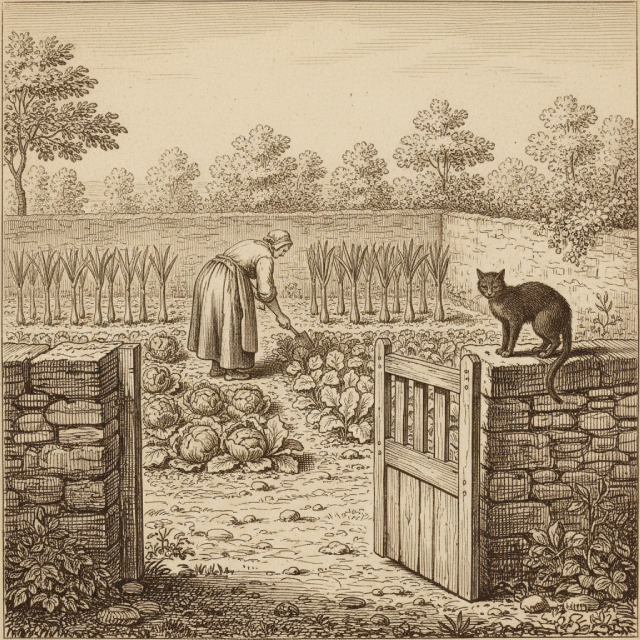
The Widow Matheron continued to grow her vegetables in peace. The village herbalist sold her tisanes without anyone questioning their composition. A woman whose black cat prowled the streets at all hours continued to prowl the streets at all hours.
The sabbaths, if indeed there had ever been any, were held without being denounced.
Anselme, for his part, prudently redirected his talents. He became a broker in land disputes — a field in which his keen sense of what belongs to whom served him admirably.
One Sunday morning in March 1683, he ran into prosecutor Daubin outside the church after mass. They exchanged a long, grave look, like two men jointly remembering a more prosperous era.
— Times change, said Daubin.
— The devil keeps a low profile, replied Anselme.
They nodded in silence, with the dignity of two professionals lamenting the whims of a difficult market.



