The Buckingham Meteor.
Previously published on my YouTube channel
There are men born to reign, and others born beautiful. George Villiers had the formidable fortune of belonging to the second category, with the devouring ambition of belonging to the first.
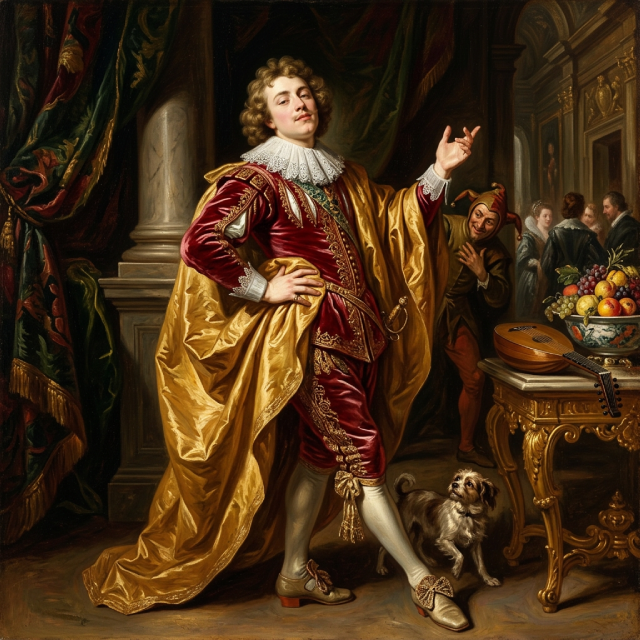
In August 1614, during a hunt at Apethorpe, a twenty-two-year-old gentleman made his entrance into history by the sole grace of his legs. For James I of England, that learned monarch who theorized about the divine right of kings while drooling over pretty boys, had very precise tastes: he liked tall, elegant men endowed with well-turned calves.
George Villiers possessed the most beautiful legs in the kingdom.
This was no metaphor, no poetic license. The young man's thighs and calves were discussed in courtly circles with the seriousness usually reserved for matters of state. And when King James saw them for the first time—displayed in tight breeches and silk stockings, during a carefully orchestrated choreography—he literally lost the power of speech.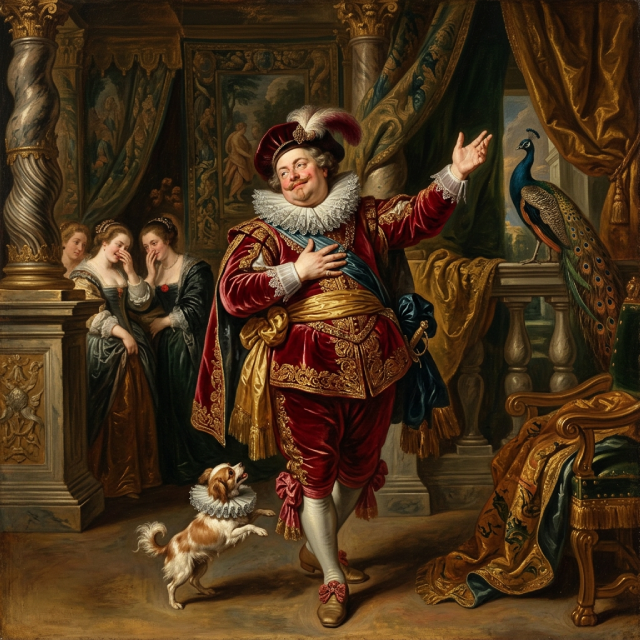
Six months later, Villiers was Gentleman of the Bedchamber. A year later, Knight of the Garter. Then Viscount, Earl, Marquess, and finally Duke of Buckingham. A dizzying ascent that would have taken three generations for a man of birth, but which his beauty accomplished in seven years. He collected titles like a greedy child collects sweets, and James showered him with gifts with the immoderation of an aging lover terrified of displeasing.
The English court watched this meteoric rise with a mixture of fascination and disgust. For George Villiers possessed not the slightest talent to justify such favor. He was not a great warrior—his military campaigns would prove catastrophically disastrous.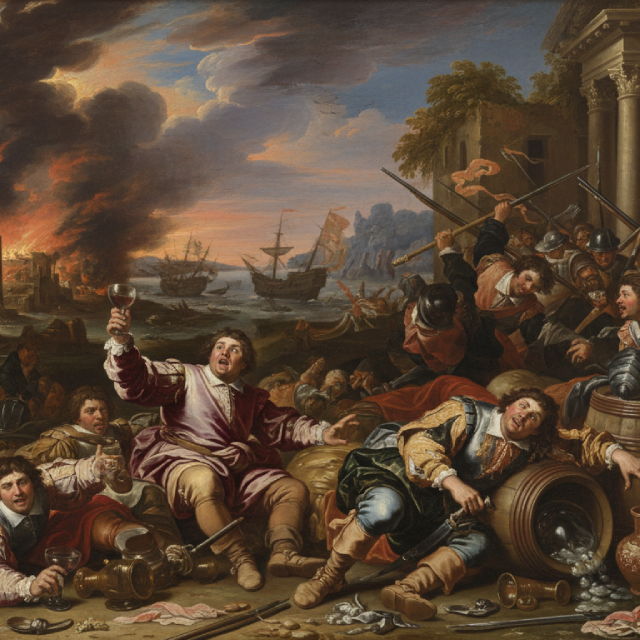
He was not a skilled diplomat—his interventions abroad regularly turned into fiascos. He was not even particularly intelligent—his letters betray a mind more concerned with appearances than substance.
But he was beautiful. And he knew how to use it.
The impertinent arrogance with which he conducted himself defied the imagination. He addressed the king with a familiarity that made old courtiers blanch. James called him "Steenie," a diminutive of Stephen, because he claimed that, like Saint Stephen in paintings, George had the face of an angel. Villiers, in return, signed his letters to the king with "your humble slave and dog." The eroticism of these exchanges fooled no one.
But Buckingham was not merely a kept favorite. He had the keen instinct of survivors. He knew that beauty fades and kings die. So when it became clear that James's health was declining, he immediately began courting the heir, Prince Charles—a shy young man, physically frail, who needed a strong friend.
A master stroke. When James I died in 1625, officially from dysentery but more probably from exhaustion (the old king had literally worn himself out loving his favorite), Buckingham did not fall. On the contrary, he became even more powerful under Charles I, whom he dominated completely.
He now had Charles. He had power. He was invincible.
He now owned York House, Somerset House, countless estates. He collected artworks with the frenzy of a man wanting to carve out immortality by proxy. He commissioned Rubens to paint a ceiling celebrating his glory—he, George Villiers, son of nobody, transformed into an allegorical figure of triumphant Virtue. The irony completely escaped him.
His wife, Katherine Manners, the richest heiress in England whom he had strategically married, gave him children whom he largely ignored. He had more important things to do: appear, shine, govern, ruin.
In 1627, he personally led an expedition to aid the Huguenots of La Rochelle, besieged by the French. It turned into a military disaster of epic proportions. Of the seven thousand men who left England, barely three thousand returned. Buckingham, who had spent more time organizing banquets and parades than planning logistics, bore direct responsibility for this carnage.
The English people, who had long hated him for his arrogance and greed, now had an excellent reason to call for his head. Parliament, emboldened, attempted to impeach him. Charles I, faithful to the point of political blindness, dissolved Parliament to protect his favorite.
Buckingham, far from learning the lesson, saw in this protection a license for even greater insolence. He wanted war with France, then with Spain, simultaneously if possible. He dreamed of military glory that would finally justify his titles. He saw himself as a new Caesar, forgetting that Caesar knew how to win his battles.
In August 1628, he was preparing a new expedition to La Rochelle. La Rochelle again! As if a second disaster could erase the first. He was residing in Portsmouth, in an inn, surrounded by his officers and courtiers. On August 23, after breakfast, he was crossing a crowded corridor.
A man emerged from the crowd. John Felton, a former officer whom Buckingham had refused to promote, a soldier who had seen his comrades die by the thousands because of the duke's incompetence. He held a simple kitchen knife, bought for ten pence.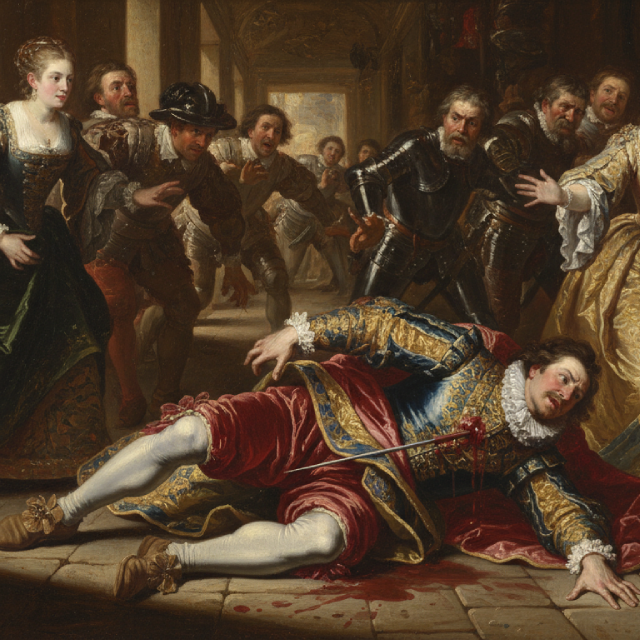
One blow. Just one. Through the silk doublet, between the ribs.
Buckingham brought his hand to his chest, touched the handle of the knife planted in his body. He staggered. "The villain has killed me!" he cried. Then he collapsed, bleeding on the stone slabs, his magnificent legs twitching in spasms.
He died within minutes. Thirty-six years old, and already finished.
When the news reached London, the people rejoiced. Bonfires were lit. They drank to Felton's health. Mothers gave their sons the name John in his honor. The murderer himself, tortured then hanged, went to his death as a popular hero. No one mourned Buckingham, except Charles I who retreated to his chamber for three days, inconsolable.
The duke was buried in the chapel of Westminster Abbey, among the kings. Even dead, he wanted his place at the top. But worms make no distinction between a royal calf and a commoner's calf. The beauty that had elevated George Villiers to the heavens decomposed like all beauties.
As for Charles I, deprived of his mentor and shield, he finally had to govern alone. Fourteen years later, his people, tired of tyranny, beheaded him on a scaffold at Whitehall. Perhaps if Buckingham had lived, he would have found a way to avoid this end—or, more probably, to precipitate it even faster.
For such was the paradox of George Villiers: a man without particular talent, without political brain, without military competence, who possessed only his beauty and his audacity, and who used them to hold an entire kingdom in his grip for fourteen years. A dazzling meteor that crossed the English sky, brilliant and destructive, before crashing in a Portsmouth inn.
He had wanted to be king without royal blood. He had reigned without a king's wisdom. And he died as all favorites who climb too high die: brutally, hated, and quickly forgotten. Except in history books, where his name remains synonymous with a certain idea of excess—that of a man who believed his beauty was enough to govern the world.
He was almost right.



