The Night of the Moika
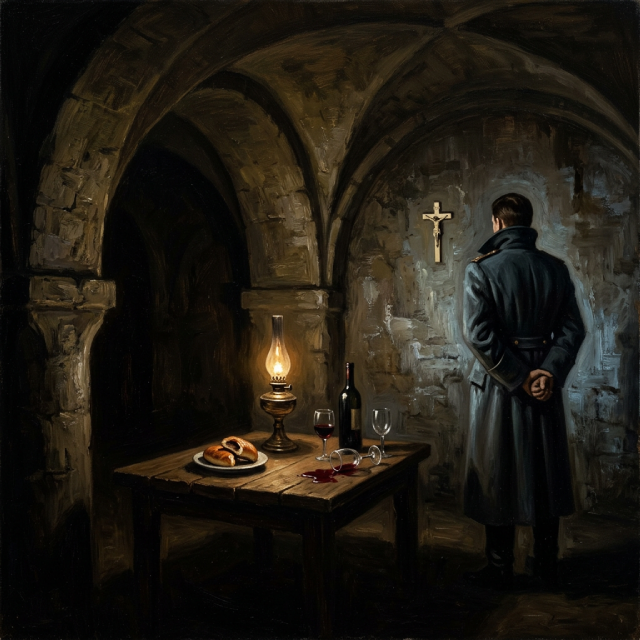
Saint Petersburg, December 16, 1916
I did not know that killing a man could take so long.
We have been waiting in this basement for hours. The fire crackles. On the table, the cyanide pastries that Maklakov prepared with a doctor's hands, precise and steady. The wine, also poisoned. We had planned everything. We are four men of good family, two officers, a deputy, and myself — Felix Yusupov, who owns palaces the Emperor himself could not afford — and we wait like servants for a peasant to deign to come down from our drawing room.
He is laughing, up there. I can hear his laughter through the ceiling. My wife is away, thankfully. We told him she was returning from a soirée. He asked for her by her given name. That alone should have been enough to convince us we were doing the right thing.
Grigori Efimovich arrived past midnight, wrapped in a pelisse that smelled of wax and incense. He took both my hands with a warmth I had not expected. His eyes — so much has been said about those eyes — are simply tired. A man who has kept too many late vigils. A man who has drunk too much wine at too many different tables and can no longer sustain the weight of his own mystery.
I led him to the basement on the pretext of letting him hear the music upstairs, that gramophone I had placed there precisely to cover our voices. Yankee Doodle, played on a loop. An absurdity. He noticed nothing.
He ate the pastries.
He drank the wine.
We waited.
Nothing.
Upstairs, my accomplices looked at one another without speaking. Purishkevich kept wiping his palms on his trousers. Dmitri Pavlovich, the Grand Duke — the Emperor's own cousin, mind you — had the complexion of a man who regrets. The physician, Lazovert, had gone pale on learning that the dose had done nothing. He had measured carefully. He had counted precisely.
There is something uniquely humiliating about the failure of poison that goes beyond mere disappointment. As though the man refused to play the role we had written for him.
I went back downstairs with a revolver borrowed from Dmitri. I told him I wanted to show him a crystal cabinet. He was looking at an ivory cross resting on the mantelpiece. He seemed almost at peace. I shot him in the back.
He fell.
For a moment, we believed it was over.
Then he got up.
I will leave you to imagine — no, I will not leave you to imagine, because you will not be able to. There are things imagination refuses. His hands on my jacket. His face so close to mine. His teeth. He called me by my baptismal name in a voice I had never heard from him before, a voice stripped of all seduction, all mystery, simply the voice of a man who understands what is happening and who is afraid.
I was afraid too. That is what shames me most, today.
We shot him again, in the courtyard. Purishkevich this time. Then one final bullet. Then we wrapped him in a curtain — a blue silk curtain, a detail I would not have chosen had I written this story — and carried him to the frozen Moika.
The body vanished beneath the black ice.
We went back inside in silence.
This morning, while changing my clothes, I found an ink stain on my cuff. Not blood — we had been careful about that. Ink, from a letter written last week to arrange the evening. A polite note, almost cordial. Do come, we shall be among friends.
I looked out at Saint Petersburg through the window. The city was white and silent the way it always is in December. Nothing had changed. The Winter Palace still stood. The Admiralty bells were striking the hour.
They would call us patriots, later. Saviors. They would say we had tried to prevent the catastrophe.
The catastrophe came fourteen weeks later.
The Empire fell in spring, the way a tree falls when no one has measured the depth of its roots. Rasputin dead, the Tsarina inconsolable, the Tsar distracted, the war without end — nothing had changed because we had understood nothing. We had killed the symptom believing we were killing the disease.
At the bottom of the Neva, our curtain of blue silk.
And there we were, that morning, sitting down to breakfast.



