Hatshepsut – The Name we no longer speak
(Narrated by Thutmose III, Pharaoh of Egypt.)
I knew her standing.
That is what people forget, when they imagine a regent, a woman in power by default, by vacancy of the throne, by the simple absence of an adult man to crown. They imagine someone seated, withdrawn, temporary. They imagine a waiting.
Hatshepsut did not know how to wait.
I was two years old when my father died. She was already there — she had always been there, royal wife, pharaoh's daughter, bearer of a bloodline purer than mine through her mother. My own mother was merely a secondary wife, a Syrian woman whose womb had produced the male heir that the Great Royal Wife had not provided. In the hierarchy of the court, Hatshepsut outranked me by several cubits, and she knew it, and I knew nothing yet.
She became regent. This seemed reasonable to everyone. A two-year-old child does not govern Egypt — even the gods concede as much. She took the reins. No one seriously objected. They waited for her to return them.
She did not return them.
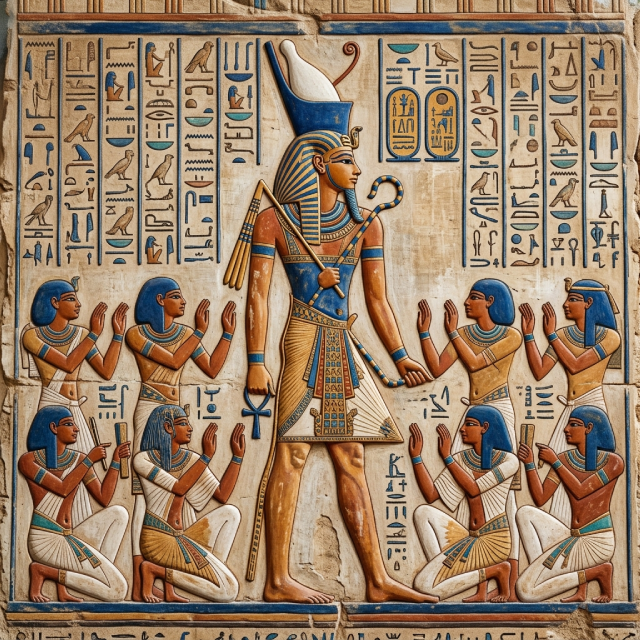
In the seventh year of my nominal reign, she had herself crowned pharaoh. Not regent, not guardian, not the king's counsellor — pharaoh. She wore the double crown, the striped nemes headdress, the braided gold false beard that men had worn since Egypt was Egypt. She had her name carved into cartouches. She had herself depicted with legs apart in the stance of male gods, shoulders squared, chest flat in the manner of ritual statues.
I lived at court. I watched her. I was learning to fight.
What is not always understood is that she was not pretending to be a man. It was not a disguise intended to deceive anyone — no one was deceived. Everyone knew. The priests, the scribes, the generals, the Nubian merchants who came to Thebes to trade their ebony and ivory — all of them knew who Hatshepsut was. The false beard was not a lie. It was an argument. It said: the attributes of power are mine because power is mine. She wielded symbols as others wield soldiers. Methodically. With no apparent hesitation.
Senenmut helped her. I did not speak his name either, later — though for different reasons. Architect, steward, tutor to her daughter Neferure, holder of some sixty titles, several of which had never been granted to anyone of such obscure birth. A man from nowhere, the son of a provincial official, who built Deir el-Bahri for her as one constructs a definitive argument against oblivion. The terraces rising toward the cliff, the alabaster columns, the reliefs narrating her divine birth — Amun himself visiting her mother, himself her father — all of it was Senenmut who calculated, who commanded, who ensured that the stone said what words could not say loudly enough.
There were whispers that he was her lover. I do not know. I know that together they built something it took me decades to not quite destroy.
She governed for twenty years. Twenty years during which Egypt prospered — which I must acknowledge because the accounts do not lie, and the accounts were good. She sent an expedition to Punt — the land of perfumes, beyond the Red Sea — and the ships returned laden with incense, with living myrrh transplanted in soil, with ebony, electrum, monkeys and leopard skins. She had the entire account carved on the walls of her temple: the ships, the trees, the queen of Punt with legs swollen by some strange ailment, the Egyptians walking through a land whose exact name they did not know. A trading expedition presented as a divine epic.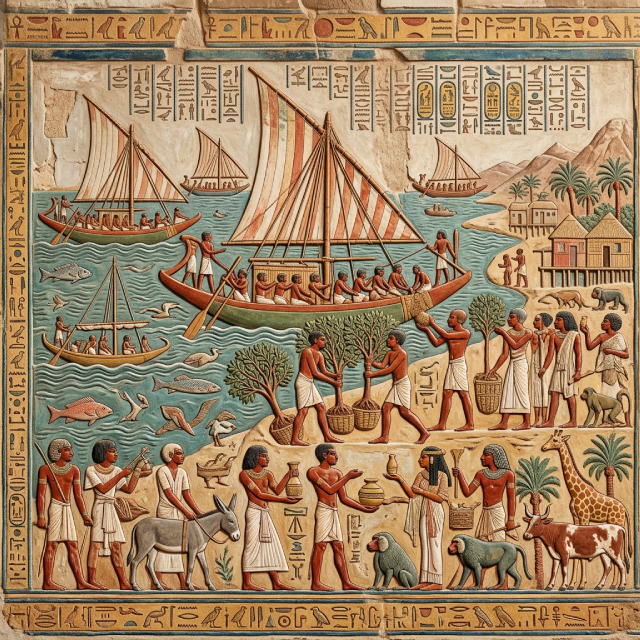
She understood that walls speak longer than men.
I left on campaign at sixteen. Perhaps she had wished it — give the boy something to occupy his hands and his mind, keep at a distance a child who was growing and whose nominal claim to the throne could not be ignored forever. I fought. I learned what years at court had not taught me: that the world is won metre by metre, that men obey whoever stands there before them, in the dust. I loved war with a simple love I never had for politics.
She died in the forty-second year of my nominal reign. The thirty-second of her actual reign. She was old, afflicted by bone cancer, from what her remains would eventually reveal — I learn this from a great distance, from a time when others will examine what is left of her. She died without anyone needing to kill her, which some have insinuated. She died simply, as everyone finally dies.
And then I took up my chisels. Metaphorically speaking.
It was patient, methodical, and began twenty years after her death — perhaps because I waited until all those who had known her in life had themselves disappeared, perhaps because I waited until I was old enough to find it urgent. Her statues were broken, buried in pits near her temple — not entirely destroyed, I notice, as though complete obliteration repelled even those carrying out my orders. Her cartouches were hammered out of the stone, her name scraped away wherever it appeared. In official representations, she was replaced by me, by my father, by my grandfather — any man whose reign could fill the blank left by her erasure.
I wanted her never to have existed. It is an understandable ambition, when one has spent twenty years reigning under another's shadow.
What I had not foreseen is that absence cries out.
Three thousand years later, men will look at the mutilated walls, the hollowed cartouches, the buried statues, and they will understand that something great has been hidden. The erasure itself will be the proof. They will excavate, compare, and reconstruct the name letter by letter from the places where my workers had done their job poorly or had not had time enough. Hatshepsut. They will pronounce it in languages neither of us could have imagined.
I gave her immortality by trying to take it from her.
Perhaps that was her final victory. I am not certain she planned it — but she was clever enough to have planned it, and that is what still unsettles me.



