The Woman Who Held the Sky
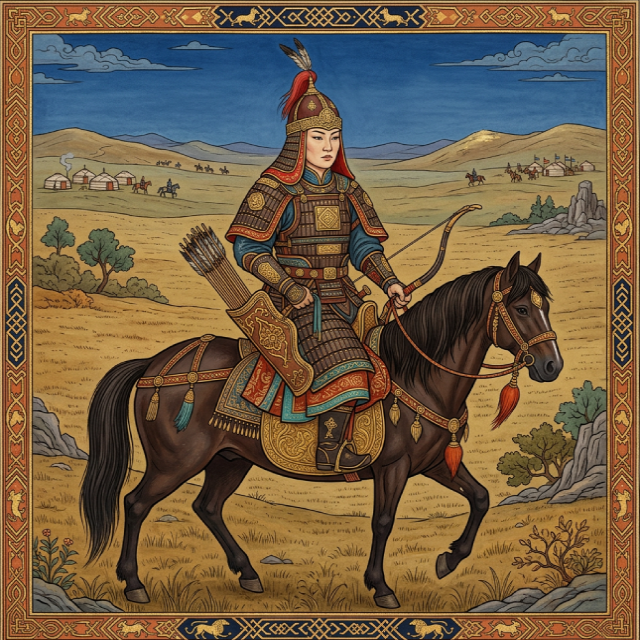
Mongolia, 1470
There was a way of looking at a steppe and seeing nothing but emptiness. Manduul Khan had possessed that gaze for several years now. The grasses rippled, the wind sculpted clouds into fleeting shapes, horses crossed the horizon like unfinished thoughts — and he watched all of it with the eyes of a man who had stopped keeping count.
The opium had arrived quietly, through the southern trade routes, in the baggage of merchants who knew how to recognize a man to whom it was useful to sell something. Manduul was not a bad man. He was simply no longer present — there in body, absent in mind, reigning over an empire that unravelled like old felt while he contemplated the ceiling of his yurt with a serenity that others might have mistaken for wisdom.
Mandukhai looked at the steppe and saw everything else.
She had married the khan at eighteen, not out of inclination but out of necessity — her own and her people's. The Mongols of 1470 were no longer what they had been. The empire of Genghis Khan, that colossus which had made China, Persia and Russia tremble in a single breath, had fractured into rival khanates, exhausted factions, succession disputes that dragged on for decades. What remained of past glory was memory alone — and the care one takes of a memory does not feed a tribe.
What was needed, Mandukhai thought with the quiet precision of a woman accustomed to thinking where others merely spoke, was a line. A thread stretched between past and future. An heir of Genghis blood, around whom the tribes could gather.
Manduul produced none. He produced very little, in truth, beyond a sweet smoke that rose from his pipe toward the Mongolian sky, and a way of nodding when spoken to that resembled agreement without being it.
Mandukhai made her decisions alone. It was more efficient.
The child's name was Batumöngke. He was seven years old when she had him brought to her — an orphan, of direct lineage, the last male descendant of the house of Genghis Khan not yet dead through his own imprudence or someone else's. He was thin, silent, and looked at adults with eyes that had already learned not to expect too much of them.
Mandukhai installed him in her yurt. Had him fed properly. Taught him to ride, to hold a bow, to listen before speaking. Those who watched the scene were uncertain what to make of it — was this politics? Tenderness? Both, most likely, and that combination was perhaps the most formidable thing about her.
Manduul died in 1478, without an heir, without having resolved much of anything. Mandukhai was a widow at twenty-nine. She could have retreated to a yurt less exposed to the draughts of history, entrusted young Batumöngke to other hands, waited.
She married Batumöngke instead.
He was eleven years old. She was twenty-nine. The thing was unusual, even for the era, but no one had the impudence to say so to her face. It was not an ordinary marriage — it was a political act of almost brutal clarity: she gave him her legitimacy as great queen, he gave her his descent from Genghis. Together, they constituted something that neither could have been separately.
The tribes understood. Slowly, as tribes always understand — out of interest first, out of conviction later — they returned to the fold.
What followed strains the limits of the plausible, but Mongolian chronicles are not known for their taste in fiction.
Mandukhai led military campaigns. Not from the rear, not symbolically: she rode with her warriors, bow across her back, against the Oirats threatening the western borders. There was a battle — historians still debate which one — during which she was pregnant with twins. She fought regardless. The twins were born. They survived.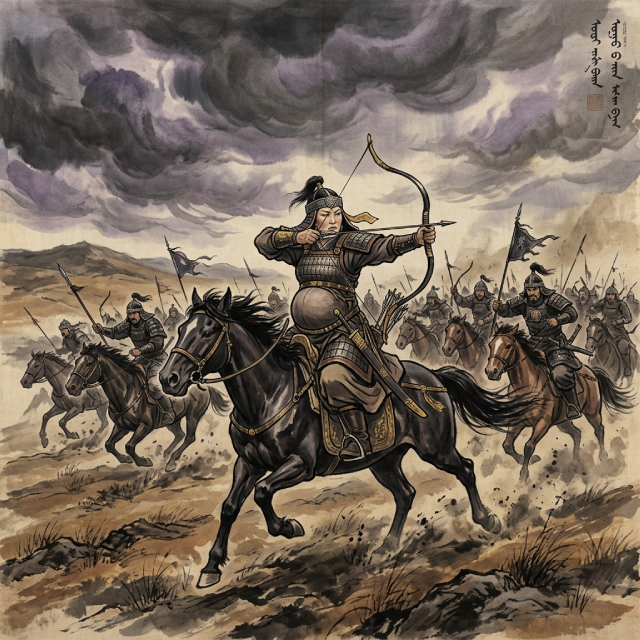
She had eight children in total with Batumöngke, who grew up while she governed, and who became in time a khan worthy of the title — which was no accident, given who had taught him to be one.
This was not power for power's sake. It was not ambition as men practice it — loud, impatient, hungry for recognition. It was something colder and more durable: the conviction that there was work to be done, that no one else would do it, and that it therefore had to be done oneself, without waiting for permission.
The Mongolian tribes called her Mandukhai Sechen — Mandukhai the Wise. The title was earned, but something is missing from it. Wisdom, as ordinarily represented, is a contemplative quality. What Mandukhai practised for thirty years was something else entirely: a wisdom in motion, an intelligence that did not pause to reflect when action was needed, that did not rush to act when reflection was required.
She died in 1510, having seen her eldest son succeed her in roughly decent order. The steppe was less fragmented than she had found it. Not reunified — history does not allow itself to be summarised so neatly — but held together. Maintained. The way one maintains something that threatens to come apart.
Manduul Khan, for his part, is remembered chiefly as her husband. History has its ironies.
There is a monument to Mandukhai in Mongolia today, erected belatedly, as all monuments to women who held things together while men looked elsewhere tend to be. She is depicted on horseback, which is fitting. She spent her life on horseback — riding toward battles, toward negotiations, toward childbirths somewhere on the steppe, between one campaign and the next.
There is no monument to Manduul's opium. But without him, perhaps, no one would ever have known what Mandukhai was capable of.



