The Painter of Invisible Mountains
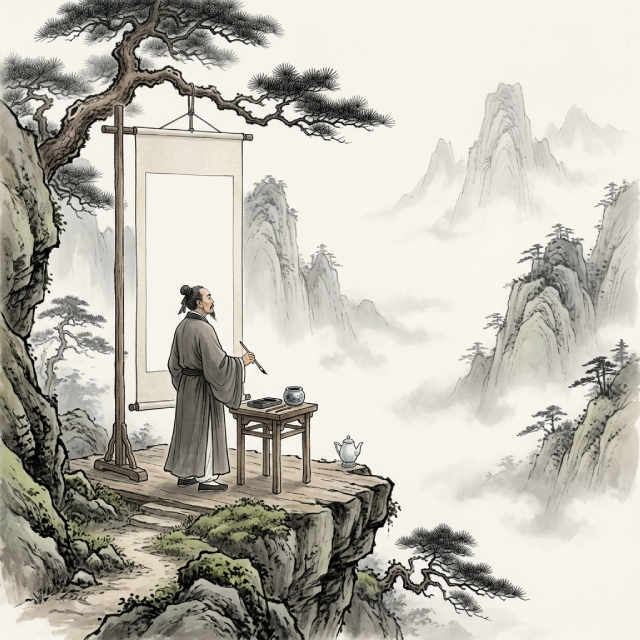
Before lines, there is breath.
In the ancient mountains, some say that the greatest masters did not paint what they saw, but what vanished at the very moment one thought one had grasped it.
This is the story of a painter who added almost nothing to the silk… and of those who, by learning to see differently, nevertheless discovered entire worlds within it.
They said that north of the Min River lived a painter who painted nothing.
Travelers who managed to reach his hut, clinging to the mountainside like a swallow’s nest, would leave with rolls of blank silk, carefully wrapped and tied with hemp thread. Sometimes they protested, demanded an explanation, but the man—with slow gestures and a clear gaze—would simply bow his head.
“The mountains are there,” he would say. “You just do not see them yet.”
His name was Liang Shen. In his youth, he had been a brilliant student at the Imperial Academy. People admired his ability to capture relief, to give breath to cliffs, depth to mist. And yet, one autumn morning, after contemplating a chain of peaks drowned in pale light, he put away his brushes and left the city without a word.
Some said he had lost his sight for three days. Others that he had a dream he never returned from. He never explained.
One late winter, a young woman named Lin Mei climbed the path to his dwelling. On her back she carried a dark wooden box, held against her like a secret.
When she arrived, breathless, Liang Shen was already waiting at the threshold, as if he had heard her steps long before they disturbed the snow.
“Master,” she said, bowing, “I was told of your paintings.”
“Then you have come to see emptiness,” he replied.
She hesitated, then placed the box between them.
“My father was a painter. Before he died, he left me this. I cannot understand it.”
Liang Shen opened the box. Inside lay an old scroll, yellowed with time. He unrolled it slowly. The silk was almost entirely blank, except for a few scattered strokes, so fine they seemed to waver between presence and disappearance.
“What do you see?” Lin Mei asked.
The old man did not answer at once. He held the scroll to the light, closed his eyes, then opened them again.
“I see what your father did not dare to finish.”
“Nothing?”
“No. Too much.”
He laid the scroll on the low table and invited her to sit.
“Mountains are not shapes,” he said softly. “They are what keeps the sky from falling.”
Lin Mei frowned.
“Then why paint them only halfway?”
Liang Shen smiled.
“Because the eye that receives must complete what the hand has begun.”
In the days that followed, Lin Mei stayed with him. She observed his gestures, the way he prepared ink, held the brush… and above all, the way he did not use it.
Sometimes he would unroll fresh silk, look at it for a long time, then roll it back up.
“You are not painting,” she said one evening.
“I paint before,” he replied.
“Before what?”
“Before the brush touches.”
He taught her to sit facing the mountain without naming it. To let contours dissolve into breath. To wait until lines appeared by themselves—not on the silk, but behind her eyelids.
“If you look with haste, you will see poorly,” he said. “If you look without trying to seize, things will come to you.”
One morning, as mist wrapped everything, Liang Shen handed her a brush.
“Today, paint.”
Lin Mei dipped the tip into ink, hesitated, then held it above the silk.
Nothing came.
She thought of cliffs, of pines clinging to rock, of rivers thin as silver threads. She wanted to trace, to fix, to hold.
Her hand trembled.
“Do not insist,” Liang Shen murmured behind her. “What you seek has already left.”
She set the brush down, frustrated.
“Then I will never see?”
The old man approached and gently took her hand.
“Look again.”
She closed her eyes.
The silence was dense, but not empty. There was the breath of wind, the slow fall of a snowflake, the faint creak of wood in the cold. And little by little, something took shape—not as a clear image, but as a presence.
A rising. A restraint. A waiting.
She opened her eyes.
Her hand lifted by itself.
One stroke.
Then another.
Then nothing more.
She stepped back.
On the silk—almost nothing. Two faint lines, slightly curved, separated by a vast space.
“It has failed,” she whispered.
Liang Shen shook his head.
“It has opened.”
Spring came slowly. Lin Mei finally descended the mountain, carrying her father’s scroll and the one she had just painted.
On the way back, she met merchants, pilgrims, soldiers. Some asked what she carried.
“Mountains,” she replied.
They laughed when they saw the empty scrolls.
But among them, an old man stopped, gazed long at the barely marked silk, and his eyes filled with tears.
“They are vast,” he said simply.
Lin Mei bowed without answering.
Years later, people spoke of a new school, born far from the academies, where one was taught to paint what cannot be seen.
As for Liang Shen, some said he vanished into the mist one windless morning. Others claimed he had never been there at all.
But in certain homes, nearly empty scrolls were kept with great care.
And when the light fell just right, immense, silent mountains would appear upon them—vast enough to keep the sky from falling.



