One Last for the Road (1/3)
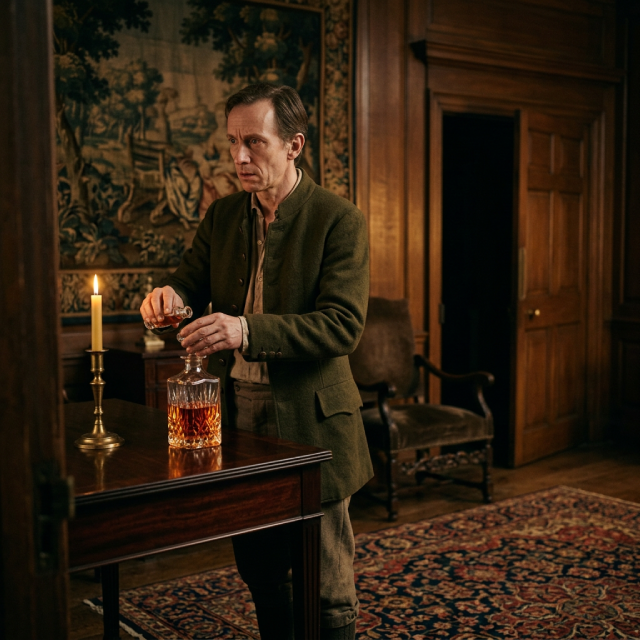
The Sologne in November possesses that creeping dampness which insinuates itself beneath wool collars and freezes the most diplomatic of smiles. Through the fogged window of the saloon car, Thibault de Saint-Rémy watched the gates of the La Chesnaye château swing open with ceremonious slowness. The estate, a vast expanse of dark woodland and brackish ponds, seemed to observe him in return, like a beast crouching in the fog. In the lining of his hunting jacket, where the fabric brushed against his left flank, a small glass vial pressed against his ribs. Digitalin was a colourless liquid, almost commonplace, yet for Thibault it represented far more than a mere chemical substance: it was his bill of exchange, his exit ticket from an existence gnawed away by creditors' demands and sideways glances in the capital's social circles.
"You're very quiet, my dear," murmured Clémence beside him. She had not turned her head, keeping her grey eyes fixed on the gravel drive leading to the ancestral house. "One would think you were heading to a firing squad rather than a family dinner."
Thibault nervously readjusted his second-hand watch, a gesture that had become a mechanical tic whenever pressure mounted. "I'm simply thinking about the management of our affairs, Clémence. This weekend is important. Your father isn't getting any younger, and the property requires an attention that... well, that we could bring to it with greater vigour."
He did not use the word inheritance. That would have been vulgar. But the concept floated between them, heavy and palpable as the smell of wet earth that seeped into the car the moment the engine died. The plan was of monastic simplicity, a masterwork of shadow that no one could suspect. Henri-Pierre de La Chesnaye, with his robustness of an old oak, had an immutable ritual: a glass of cognac before retiring, served from a crystal decanter of which he was the sole user. A few drops of digitalin would suffice to transform this nocturnal pleasure into a natural cardiac failure, a fitting and expected end for a man of seventy-two with arteries no doubt worn thin.
The welcome was, as always, a courtesy bordering on hostility. Béatrice de La Chesnaye awaited them in the great hall, a glacial space where Henri-Pierre's hunting trophies seemed to pass judgement on new arrivals. She wore a moss-green tweed suit that blended into the tapestries, her pearls gleaming with a milky lustre beneath the crystal chandelier. She kissed Clémence on both cheeks with the distance of a queen receiving a fallen ambassadress, then turned upon Thibault a gaze that seemed to weigh every missing euro in his bank account.
"Thibault, always that look of a provincial solicitor," she said in a voice that was no more than a cutting whisper. "I hope you haven't brought your bankruptcy files in your luggage. The Sologne demands wit, not a shopkeeper's sums."
"I assure you, dear mother-in-law, that my mind is entirely turned toward the pleasure of seeing you again," he replied with a façade of a smile, his spine bent just enough not to appear servile, while remaining unthreatening. "Fate does sometimes harry one's affairs, but family remains a sanctuary."
Dinner was an ordeal of patience. Béatrice did not cease to harry Clémence over the management of the tenant farms, highlighting every small error with an accountant's precision. Henri-Pierre, for his part, remained massive and silent, chewing his meat with bovine slowness, rousing himself from his torpor only to grunt technical approval regarding the state of the woodland. Thibault waited his hour. He watched for the moment when the conversation would drift toward domestic details, offering the necessary diversion.
The opportunity presented itself around ten o'clock. Béatrice drew Clémence toward the domestic offices for an impromptu inspection of the silverware, leaving the men alone. Henri-Pierre rose heavily.
"I'll go and see that the dogs are properly in," he growled, making for the terrace. "Help yourself to coffee, Saint-Rémy. You look as though you need some to keep your eyelids open."
Thibault did not waste a second. The moment his father-in-law's heavy footstep receded, he slipped into the adjoining small sitting room, where the drinks tray held court upon a mahogany console. His hands did not tremble. He drew the vial from his lining, unscrewed the stopper with a jeweller's precision, and tilted the vessel above the cognac decanter. The liquid fell in a silent cascade, mingling with the deep amber of the spirit. It was done. The perfect crime was under way, without trace, without sound.
He was replacing the vial when an absurd event occurred. A violent draught, born of an improperly latched window somewhere in the corridor, surged into the room. The sitting room shutters slammed against the stone with a thunderclap. The vibration was such that the crystal decanter, unsteady on its tray, toppled and emptied itself entirely onto the Persian rug with its intricate motifs. The smell of cognac rose immediately, filling the space.
"This is absolutely intolerable," Thibault swore under his breath, his heart leaping in his chest. The poison was no longer in the vessel; it was now soaking into the fibres of the century-old wool. If he left the stain, the smell or the sight of the disaster would draw attention. In a fit of nervous panic, he threw himself to his knees, pulling out his silk handkerchief to frantically blot the lethal liquid before the La Chesnayes returned.
It was in this humiliating position, on all fours, his nose against the fleur-de-lys pattern, that Henri-Pierre found him. The old man stopped in the doorway, one hand on his hip, one bushy eyebrow raised.
"Well then, Saint-Rémy, are you searching for loose change, or trying to decipher the manufacture date of that rug?"
Thibault straightened in one movement, his face crimson, his handkerchief soaked with poison and cognac concealed in his palm. "I... I was clumsy, dear Henri-Pierre. The wind made the shutters bang, and I knocked over your decanter. I was attempting to repair the damage."
His father-in-law burst into a coarse laugh that shook his broad shoulders. "A son-in-law who does the housework — there's an image Béatrice would appreciate! Leave the poor rug, it's seen worse. Besides, that cognac was beginning to turn."
Thibault hoped to slip away to burn his handkerchief, but Henri-Pierre advanced toward a hidden piece of furniture, a cabinet from which he produced a collector's bottle, a dusty relic labelled in cursive script. "Since you've ruined tomorrow's nightcap, we shall celebrate your clumsiness with something serious. An armagnac my father bottled before you knew how to tie your shoelaces."
Thibault was compelled to sit. For the two hours that followed, he was forced to drink with his quarry. Every mouthful of the burning spirit reminded him of the poison still saturating his fingers, hidden beneath the table. He feared that some infinitesimal particle of digitalin might have crept onto the rim of his own glass or beneath his fingernails. He watched Henri-Pierre laugh, recount bloody hunting anecdotes, utterly oblivious to the fact that he had just escaped death through the simple grace of a Sologne draught.
Toward midnight, Béatrice appeared in the doorway like a spectral apparition. She surveyed the empty bottle and the still-damp rug.
"Henri-Pierre, you reek of alcohol, and your son-in-law looks like a man condemned to death," she said in a flat tone. "Thibault, you are decidedly good for nothing. Not only do you not know how to make a capital grow, you cannot even hold a decanter without breaking it. Go to bed — your presence is exhausting."
Clémence, standing behind her mother, said not a word. She met her husband's gaze, a look imbued with infinite weariness, before looking away. Thibault rose, his head spinning, his stomach knotted by an early hangover and a black frustration. His first attempt, prepared over months with a scientist's meticulousness, had ended in ridicule and alcoholic fumes. Climbing the oak staircase that creaked beneath his step, he felt the empty vial in his pocket. Fate was hounding him, that much was clear. But he had not yet said his last word. Digitalin was only a beginning, and the La Chesnaye estate concealed dangers far greater than a simple draught.



