The Potter and the Crack
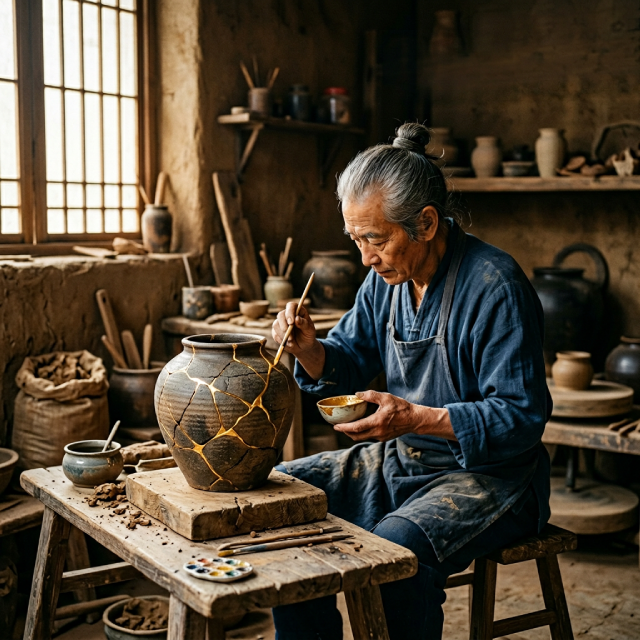
In certain patient hands, the crack is not an end, but an invitation to see what remains in a new light.
At the edge of a village shaped by dust and wind lived a potter whose jars and cups never remained whole. Sooner or later, each one would crack. Some saw it as a flaw. Others, as misfortune.
But those who returned years later spoke differently.
“They change,” they said.
The potter ‘s name was Han Gu.
He worked in an open workshop, where air moved freely, as if nothing wished to be confined.
One day, a merchant named Bo arrived with a large order.
“I need sturdy jars,” he said. “Perfect. Without defects.”
Han Gu nodded.
He shaped the clay with care, turned it slowly, fired it long. The jars were beautiful, balanced, without visible flaw. The merchant left satisfied.
But months later, he returned, furious.
“They crack! All of them!”
Han Gu observed the fine lines spreading across the surface.
“Yes,” he said simply.
“Then they are failures!”
The potter shook his head.
“No. They are beginning.”
Intrigued despite himself, Bo stayed.
In the following days, he watched Han Gu work. He noticed something strange: the potter did not try to prevent the crack. Sometimes, he seemed to wait for it.
“Why not make them stronger?” Bo asked.
“They already are,” Han Gu replied.
“They break.”
“They open.”
One morning, a jar split with a soft sound.
Bo stepped closer.
“This one is ruined.”
Han Gu lifted it, turned it toward the light. The crack traced an irregular path, almost alive.
The potter prepared a dark lacquer, mixed it with fine gold powder, and with slow precision followed the broken line.
“What are you doing?” Bo asked.
“Listening,” he replied.
“A crack does not speak.”
Han Gu smiled.
“It shows where the form stopped, and where it can continue.”
When the lacquer dried, the jar bore a luminous scar, crossing its surface like frozen lightning.
Bo fell silent.
Weeks passed.
The merchant watched other jars, other cracks, all different. None were hidden. All were followed, revealed.
And slowly, he understood: these lines were not flaws, but paths.
“They are more beautiful this way,” he whispered one day.
Han Gu nodded.
“Because they no longer pretend to be whole.”
Before leaving, Bo asked:
“Can this be learned?”
The potter handed him a small bowl.
“Wait.”
A few days later, a fine crack appeared.
Bo studied it for a long time. Then, hesitantly, he took the lacquer. His hand trembled. He wanted to correct, to embellish. Then he remembered. He simply followed the line.
When he finished, the bowl was neither perfect nor repaired.
But it had become something else.
He looked up.
Han Gu was smiling.
“Now, you see.”
Years later, people sought Han Gu’s jars and cups. They were scattered, passed from hand to hand. Some had been broken. Others bore several golden scars. Yet all seemed to hold something greater than their form.
And those who drank from these cups sometimes said the water tasted different.
As if, through the crack, the world itself had found a way in.



