The Last of the Habsburgs
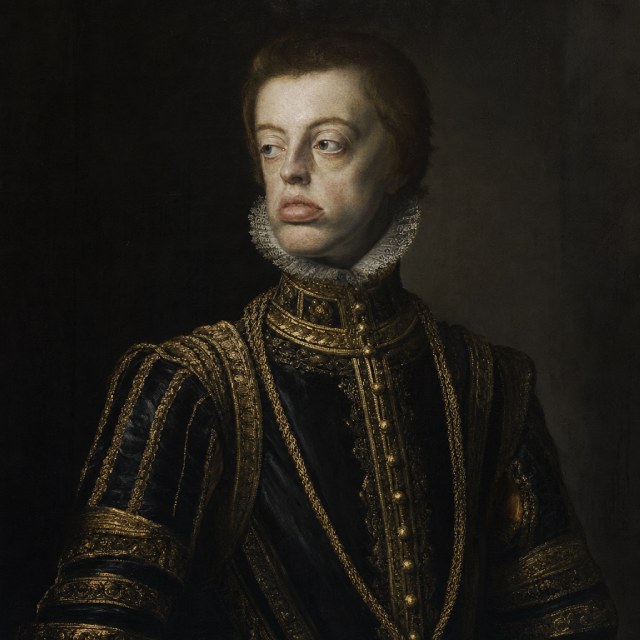
Madrid, November 1700.
Charles II of Spain took thirty-seven minutes to die — or rather, to finish dying, since the essential part had been accomplished long before.
He was thirty-eight years old. The physicians who performed his autopsy — a procedure to which the Habsburgs submitted with the regularity of a dynastic obligation — noted that he had virtually no recognizable brain, only one testicle and that one atrophied, that his heart was "the size of a peppercorn," and that his stomach and intestines were gangrenous. They set down this finding with the meticulous care reserved for things one does not understand and hopes never to see again.
What they could not write — because genetics did not yet exist as a science, and the word chromosome would wait another two centuries — is what we know today with an almost indecent precision: Charles II of Spain had a coefficient of inbreeding higher than if he had been born of a union between brother and sister. According to the modern geneticists who have reconstructed his family tree, he was more closely related to himself than to his own parents. The sentence means nothing and means everything.
The House of Habsburg had settled the question of succession with the logic of a family business: one does not dilute the capital, one concentrates it. For two centuries, cousins had married cousins, uncles nieces, and on occasion — as with Philip II, the father of his great-great-grandfather — a direct niece. Each marriage reduced the gene pool a little further, like tightening a knot — until the knot was no longer a bond but a stranglehold.
Charles was the culmination of this calculation. His father, Philip IV, had himself married his niece Mariana of Austria, thirty years his junior, because the acceptable options had narrowed to a few families, and those few families had long since merged into their own. Charles was born in 1661 of this union, the fourth child, the only survivor. His brothers and sisters had died in infancy with the regularity of a natural law that no one at court thought to question.
He walked at ten. He spoke more or less correctly around the same age. He was never weaned normally — his prognathous jaw, an accumulated Habsburg inheritance like a piece of furniture each generation enlarges without knowing where to put it, prevented him from closing his mouth properly and made chewing difficult. He drooled. He was never able to learn to read without assistance. They called him encantado — bewitched — because the court of Madrid preferred supernatural explanation to clinical observation.
He was married twice, to Marie-Louise of Orléans and then to Maria Anna of Neuburg — two women brought in succession to a bed where nothing happened, or nothing that left a trace. No heir. The court, the Church, the Inquisition all looked for an explanation. Sorcery was the diagnosis, exorcism the treatment. They were administered. Nothing changed.
What could have changed? The body had run out of margins. There was nothing left to transmit.
He died therefore in November 1700, after a long series of crises, convulsions, fevers, and that progressive collapse of everything else. He had spent his final weeks unable to rise. The memoirs of the period mention a particular smell in his apartments that no one could eliminate.
What genealogy had taken two centuries to construct, biology had taken thirty-eight years to undo. With the stubbornness of systems that refuse to admit their own end, the court of Madrid continued, until his last breath, to treat this man as what he was on paper: the Catholic King, the most powerful monarch in Christendom, the convergence point of an entire political civilization.
Convergence point — that was precisely the word. The House of Habsburg had converged for so long, so methodically, that it had ended by rejoining itself — and within that perfect ring, there was nothing left to pass on.



