What the Sea Took
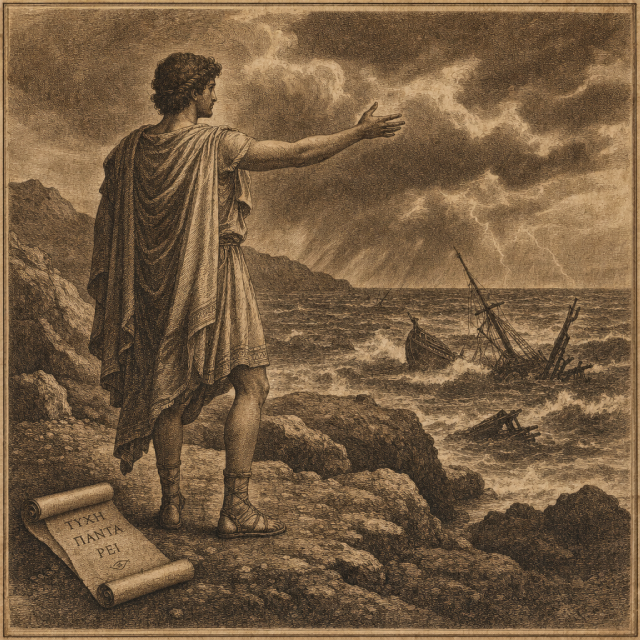
Citium, Cyprus, around 333 BCE. Zeno is twenty-two years old and a merchant of purple dye, as his father was, as his father's father before him. It is a trade that smells strongly and pays well. He has loaded his bales onto a Phoenician vessel bound for Piraeus — a cargo of dye, dyed cloth, a few scrolls purchased in Tyre because someone told him that in Athens booksellers make fortunes. He does not yet know that this is the last time he will be a merchant.
The Mediterranean in autumn does not ask permission. The storm arrives as all serious catastrophes do: quickly, and without rhetoric. The ship sinks. Zeno survives — no one knows how, the sources disagree on this detail, and perhaps that is just as well, because the way one escapes death is less interesting than what one does afterward. He arrives at Piraeus with what he has on him. The cargo is at the bottom of the Aegean Sea. The paternal fortune, transmitted in the form of merchandise because that is how wealth traveled in those days, has ceased to exist.
He is twenty-two years old. He is in Athens. He has nothing left.
The rest is known in broad outline, and broad outlines rarely suffice to understand what truly happened. Zeno enters a bookshop — out of idleness, by chance, because it is raining, no one knows. He comes across Xenophon's Memorabilia, the book that records the conversations of Socrates. He reads. He asks the bookseller where one might find men such as this. The bookseller points to a passer-by in the street: Crates of Thebes, Cynic philosopher, walking barefoot and possessing exactly what he can carry. Zeno follows him.
It is a story too neat to be entirely true. Sudden conversions do not happen like that, without resistance, without relapse, without the interstitial period during which one is simultaneously the old self and the new. But there is something in this structure — the shipwreck, the bookshop, the philosopher in the street — that says something true about what loss does to people, when it does not destroy them.
It makes them available.
What Zeno lost in that shipwreck was not only money. It was an entire identity. Merchant's son, merchant himself, inscribed in a family continuity, in a commercial network, in a precise social position — all of it rested on the cargo. The cargo is at the bottom. So he too, in a sense, is at the bottom. He must rebuild from what remains when everything else is removed.
What remains, he will spend thirty years formulating properly, but the intuition is there from the beginning: what remains is the manner in which one holds oneself before things. Not the things themselves.
The Stoics would call it hegemonikon — the governing faculty, that center within oneself that receives the world's blows and decides what to make of them. One does not control the storm. One does not control what the sea takes. One controls the posture one adopts before loss, and that posture is the one thing the sea cannot reach because it is not made of matter.
But Zeno is not there yet. For now he is following a barefoot philosopher through the streets of Athens, and he is, according to the accounts, deeply embarrassed to be doing so.
He would found the Stoa twenty years later. The Stoa Poikilè — the painted porch — where he would teach standing, walking, without a fixed school, without enrollment fees, without the ritual hierarchies of the Platonic academies. Anyone can stop and listen. Anyone can leave. The teaching itself is impermanent, open to all winds.
This is probably not a coincidence.
The central principle he would formulate, and which his successors would refine over centuries, can be stated in few words: distinguish what depends on you from what does not, and attach your happiness only to the first category. Everything else — health, fortune, reputation, the people one loves — belongs to the second. Not that one should be indifferent to these things. Not that one should love nothing. But one must love knowingly.
Love knowingly — knowing that the sea can take back what it gave. That bodies age and stop. That fortunes change hands. That empires that seem eternal have an end date that someone, somewhere in the future, will be able to read in a book.
This is not an invitation to indifference. It is an invitation to a more honest form of love than ordinary love — one that does not require the beloved to last.
Zeno died old, in Athens, after a fall — he had broken a toe stumbling on his way out of the school. According to Diogenes Laërtius, he struck the ground with his hand and said: I am coming — why do you call me? Then he held his breath until he died.
No one knows if this is true. No one knows if it is a pious legend constructed after the fact to give his death the perfect shape of his philosophy. But even as legend, it says something.
He had not waited for death. He had gone to meet it with the same disposition he had cultivated all his life: without illusion about what things are, and without regret for having loved what does not last.
The cargo had been at the bottom for sixty years. He had not spoken of it for a long time. But without it, there would have been no Stoa, no Marcus Aurelius writing his notebooks in the mud of the Danube, no Epictetus articulating as a slave what emperors would struggle to learn.
The sea had taken the purple. It had left the rest.



