Sunni Ali Ber — The Fire and the River
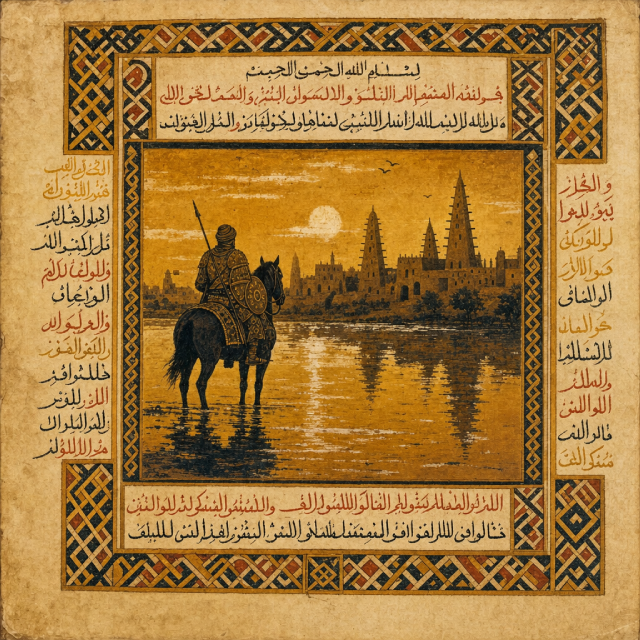
He was born in a borderland, between two worlds that did not understand each other. His mother was Faru, a people of Sokoto who carried ancient animist traditions; his father ruled Gao, a city of trade and mosques. They say he learned magic from his mother before he learned the suras. They say many things about Sunni Ali, and almost all of it comes from those who hated him.
The chroniclers of Timbuktu never forgave him. The Tarikh al-Sudan, written by the clerics of the city he had conquered, describes him as a tyrant, an unbeliever, a persecutor of scholars. What they do not say clearly is that he was above all someone who did not fear them — and that, for an elite accustomed to weighing the balance of power, was unforgivable.
In 1464, he ascended the throne of Gao. The Songhai kingdom was modest then: a city-state at the eastern bend of the Niger, rich in its river but narrow in its horizons. The Mali Empire, which had long dominated the entire region, was collapsing under its own dynastic contradictions. There was a void. Sunni Ali saw it, and entered it like a blade.
His first great campaign was Timbuktu, in 1468. The city had been held by the Tuareg for several decades; it received him reluctantly, under pressure, and its literate inhabitants watched him enter with a mistrust that would never dissolve. He did not care. He was not seeking the approval of the ulamas — those Islamic jurists who governed the university of Sankore and weighed consciences on the scales of doctrine. He was seeking control of the trade routes that ran through their streets.
What set him apart from his predecessors was not brutality — medieval West African history has no shortage of that — but method. He was the first ruler in the region to deploy a river fleet as a systematic instrument of war. On the Niger, he had war canoes built, hundreds according to the chronicles, which allowed him to project his cavalry from one bank to the other faster than his enemies could anticipate. The river his ancestors had crossed on foot became a highway of conquest.
Djenné fell in 1473, after a seven-year siege. It was the most prosperous city on the Niger bend, a node of exchange between the Sahara and the forest, between the gold of the south and the salt of the north. Sunni Ali did not destroy it — he absorbed it. He had understood something many conquerors forget: cities are only worth something if they function. He installed governors, reorganised the irrigation channels of the inner delta, increased agricultural quotas. The brutality of conquest was followed by a pragmatic administration, almost cold in its efficiency.
Thirty campaigns in twenty-eight years. The Dogon, the Mossi, the Fulbe, the remnants of the Mali Empire — he pushed them back, outflanked them, absorbed them. The chronicles say he never lost a battle. Perhaps an exaggeration, perhaps not. What is certain is that under his reign, Songhai grew from a mid-sized kingdom into an empire of one and a half million square kilometres.
He called himself a Muslim. He prayed, apparently. But he continued to practise the rites of his mother, to consult diviners, to wear amulets that the clerics considered sorcery. The scholars of Timbuktu, who expected an Islamic king to treat them as spiritual advisors, found themselves marginalised, sometimes persecuted. Some fled. Some stayed and wrote, in their libraries, acid portraits of a man they could neither control nor understand.
What they did not write, or wrote little of: that Songhai peasants sometimes called him liberator. That his legitimacy came not from the mosque but from the river, from the land, from a popular identity that the learned Islam of Timbuktu looked down upon. That he embodied something older and more complex than the figure of the Muslim warrior-king his enemies wished to set against him.
He died in November 1492 — the same year Christopher Columbus touched a shore he had not been looking for. The death of Sunni Ali is obscure: drowned in a flooded river, according to some, ambushed according to others. He was sixty years old, perhaps more. His son Sunni Baru succeeded him, but one of his generals — a pious and ambitious man named Muhammad Ture — refused to kneel before an heir he considered insufficiently Islamic.
Six months later, Sunni Baru was defeated and deposed.
The empire Sunni Ali had spent twenty-eight years building passed, intact, into other hands. That may be the most honest measure of what he had accomplished: he had built something solid enough to survive his own death, and the betrayal of those who came after.
The chroniclers of Timbuktu wrote that he was damned. That Allah had not pitied him. That his crimes were too great to hope for forgiveness.
But they went on living in his city.



