Askia Mohammed — The Pilgrim and the Usurper
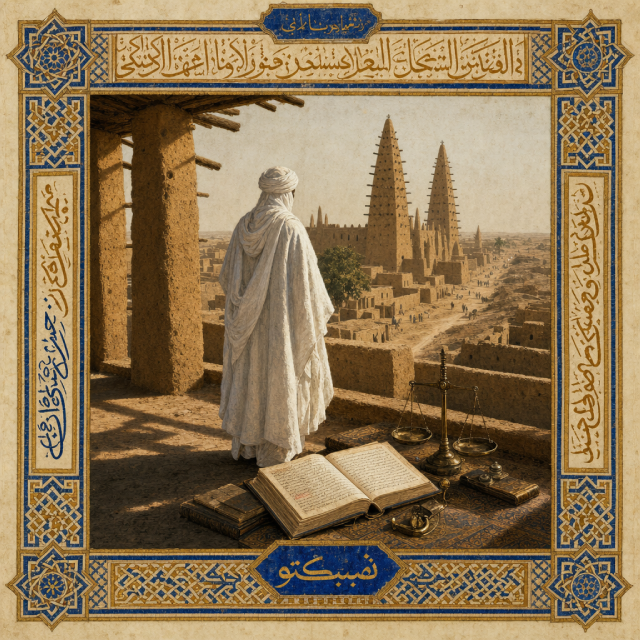
He had served the man he would betray for years. A general under Sunni Ali, loyal in appearance, he watched with growing revulsion as this king prayed in the morning and consulted diviners in the evening, who filled mosques with soldiers and granaries with slaves, who dismissed the scholars of Timbuktu the way others dismiss servants who talk too much.
Muhammad Ture — the man who would be called Askia Mohammed, or Askia the Great — was sincerely devout, or at least skilled enough at appearing so that the distinction never really mattered. When Sunni Ali died in 1492 and his son Sunni Baru took the throne, Muhammad Ture waited six months. Then he declared that the new heir was a poor Muslim, that it was his duty to overthrow him, and he did so at the battle of Anfao in April 1493.
It was a coup dressed as religious reform. It would not be the first time that had happened in history, nor the last.
But reducing Askia Mohammed to his opportunism would be as unfair as reducing Sunni Ali to his brutality. He had a vision — and the intellectual means to articulate it, something his predecessor had never sought to do.
In 1496, three years after taking the throne, he undertook the pilgrimage to Mecca. This was not private devotion: it was a political declaration addressed to the entire Islamic world. He crossed the Sahara with a caravan of several hundred people and, it is said, three hundred thousand gold coins. At every stop, he distributed alms, met jurists, debated theology. In Cairo, he was received as a sovereign, not a provincial. In Mecca, the sharif of the city conferred on him the title of caliph of the western Sudan — representative of Islam for all of West Africa.
He returned changed, or at least equipped with what he had set out to find: a legitimacy that owed nothing to Sunni Ali, nothing to the Sunni lineage, nothing to the popular traditions of the river. His legitimacy came from God, by way of the Hejaz.
The reign that followed was one of invisible architecture. Where Sunni Ali had built an empire through war, Askia Mohammed restructured it through administration. He divided the territory into provinces, placed at their head governors appointed and removable by him alone, standardised weights and measures for trans-Saharan trade, and made Timbuktu what it had never quite been under his predecessor: an officially recognised intellectual capital.
The university of Sankore reached under his reign a reputation that few institutions in the medieval world could match. Students came from Egypt, Morocco, Andalusia. The jurists he consulted on questions of governance — how to administer an Islamic empire, how to treat non-Muslims, how to legitimise war — were among the finest minds of their age. Ahmad ibn Muhammad al-Maghili, a jurist from Tlemcen, wrote him a treatise on Islamic government that Askia put into practice. This was not intellectual decoration: it was the constitution of his empire.
He waged wars too — piety did not replace the sword. He extended Songhai eastward, reached the Hausa lands, imposed tribute on the Tuareg. But his wars carried a rhetoric that Sunni Ali's had never possessed: he waged them in the name of Islam, against rulers he declared insufficiently orthodox. Jihad as an instrument of foreign policy.
He reigned for thirty-five years. Toward the end, he went blind — the chronicles do not specify whether from illness or from something more symbolic in the old age of a man who had looked so far. In 1528, his sons deposed him and exiled him to an island in the Niger. The irony was almost too neat: the man who had overthrown an illegitimate heir was himself overthrown by his own legitimate ones.
He lived another ten years in exile, brought home finally shortly before his death. He died in 1538, or perhaps 1539 — the sources do not agree on the details of his end, as though history, having favoured him so long, withdrew from him at the last the precision he deserved.
What he left behind was considerable. The empire was intact, even if his sons would quickly dispute what he had preserved. The libraries of Timbuktu were full. The trade routes functioned. The Songhai's reputation in the Islamic world was at its zenith.
And then, sixty years later, the cannons of Al-Mansur of Morocco crossed the Sahara, and at the battle of Tondibi in 1591, the Songhai army — which had never encountered arquebuses — was scattered within hours. Timbuktu was sacked. The manuscripts were hidden in walls, under floors, in wells. The scholars fled or died.
Askia Mohammed was no longer there to see it. But the empire he had so carefully administered survived his own deposition by only two generations.
Sunni Ali had built like a fire: fast, high, with a heat that consumed as much as it illuminated. Askia Mohammed had built like an architect: patiently, in stone, with plans and measurements. Both were right. Both were wrong.
What remained, when everything had burned, were the manuscripts that the clerks of Timbuktu had hidden in the darkness — those same clerks whom Sunni Ali had despised and Askia Mohammed had honoured. The memory of the empire survived in libraries, not in palaces.
Perhaps that is the true lesson of Timbuktu.



