Maeve, Queen of Connacht
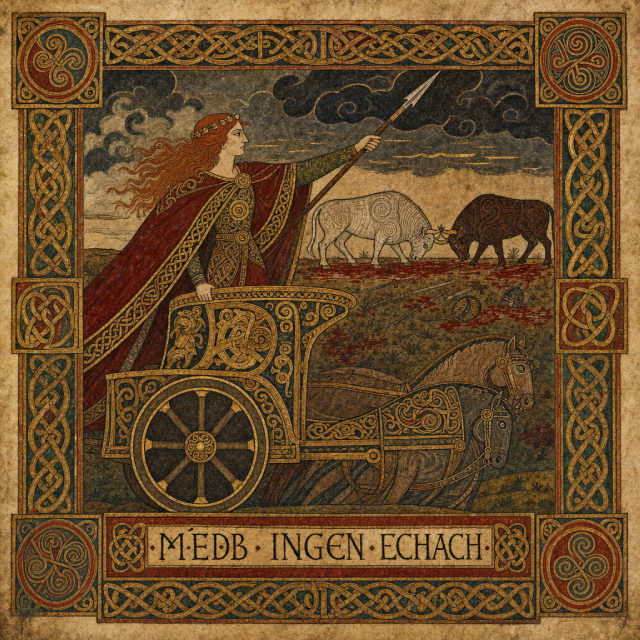
She did not ask for peace. She did not ask for mercy. She asked for equality — and when it was refused, she raised armies.
Maeve of Ireland belongs to none of the soft women history enjoys crowning. Daughter of the High King Eochu Feidlech, she was given Connacht to govern at a time when such a gift should have satisfied any female ambition. It did not satisfy her. She required of her husbands the same absence of fear, pettiness, and jealousy she demanded of herself — three precise conditions, spoken without shame, like contractual clauses carved into stone. Ailill mac Máta, the last of them, came close to meeting them. Close was never enough for Maeve.
The war of the Brown Bull of Cooley — the Táin Bó Cúailnge — was born from a bedtime argument. Ailill and Maeve were comparing their respective wealth as the evening fell, object by object, herd by herd, and the scales tipped by a hair in Ailill's favor: his white bull, the Finnbhennach, surpassed everything Maeve owned. That imbalance — infinitesimal yet enormous — she could not endure. She wanted the Donn Cúailnge, the brown bull of Ulster, the only beast that could equal her husband's. She demanded it. She was refused. She sent tens of thousands of men to die for it.
What strikes the reader of the old Ulster Cycle transcriptions is the absence of moral condemnation toward Maeve. The medieval scribes — all religious, all male — record her actions without the horror they reserved for the women of Norse sagas or the witches of hagiographies. Maeve lies, negotiates, seduces, betrays, commands — and the prose moves forward, cold and factual, as though none of this required remark. Perhaps because within the old Celtic narrative structure, it truly required none. Sovereignty in archaic Ireland was feminine by essence: the king married the land, but it was the land that chose.
Maeve was sovereignty. A goddess before she was a queen, incarnation of flaith — that sacred power which granted or withheld the right to rule — she bestowed her favor on kings and withdrew it without explanation. She lay with nine kings of Ireland, it is said. Each reigned only because she permitted it.
She died as she had lived: in the flash of an ordinary moment. Ferbaé, son of Conchobar mac Nessa, struck her down while she was bathing in a lake, with a piece of hard cheese hurled from the opposite bank. The legend specifies that Ferbaé had practiced this throw for years, waiting for his moment. Even her death has something absurd and sharp, tragicomic — in keeping with a life spent proving that the rules of the world could be bent by whoever was bold enough to seize them with both hands.
She was buried upright, it is said, armed, facing Ulster, her enemies to the last.



