The People Upstairs
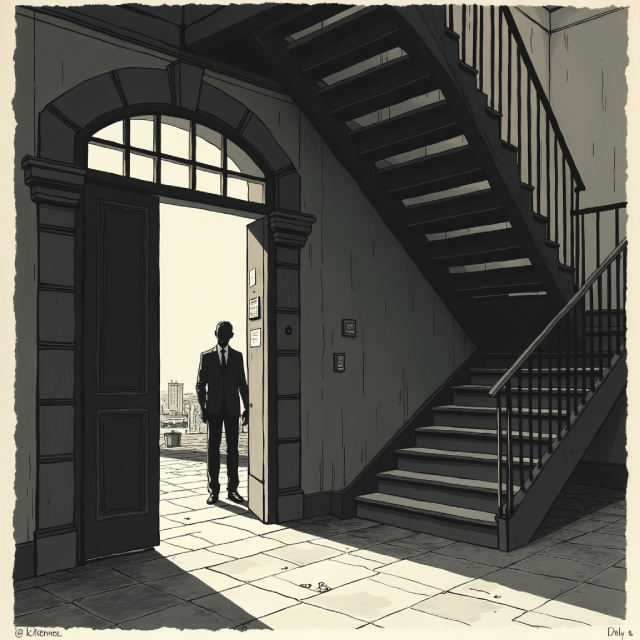
Nadia Ferreira was forty-four years old, had a third-floor apartment, and a neighbour on the floor upstairs whose first name she had never learned.
It wasn't indifference. It was that the neighbour had never seemed to want anyone to ask. She collected her mail without looking up, brought in her groceries in three exact trips, and had a way of waiting for the lift that discouraged any attempt at conversation. After eighteen months in the same building, Nadia had concluded that some people choose to exist only in outline, and that this was their right.
Then there had been the co-owners' meeting.
The meeting concerned, among other items on the agenda, the renovation of the stairwell. Nadia had arrived intending to vote in favour, go home, and remember very little. She left two hours later with an enmity she had not ordered.
The neighbour downstairs was called Miss Coste. Nadia learned this by hearing the building manager call her by name, then by watching her oppose, with surgical precision, every point Nadia raised — not out of any apparent conviction, it seemed, but as if opposition were a reflex in her, a kind of vital function.
The vote on the stairwell was nothing urgent. Nadia had explained, with figures, why deferring was more expensive than acting now. Miss Coste had said the figures were optimistic, in a tone that implied she found Nadia naïve. Nadia held her position. Miss Coste voted against. Two other co-owners, perhaps intimidated, perhaps simply tired, followed.
The renovation was deferred.
What followed, Nadia would not have predicted.
She had started to hear her. Miss Coste. Where before there had been only the neutral noise of an inhabited apartment — footsteps, a television, a flushing toilet — there was now someone. Someone who set her heels down too hard. Someone who moved furniture at improbable hours. Someone whose washing machine seemed to start up precisely as Nadia was falling asleep.
She knew, in the part of herself that remained lucid, that Miss Coste was probably doing nothing different from what she had always done. That the heels had always echoed, that the machine had always run, that the stone building from the 1930s transmitted sound with complete indifference to human considerations.
She knew this. She heard something else.
One evening, Nadia found herself composing in her head a note she would slip under the door. A polite, measured note, simply explaining that sound carried easily in older buildings, and that perhaps Miss Coste could, if it wasn't too much to ask, walk with a little less... She stopped there. Not because she thought the idea was inherently wrong, but because she had just realised something.
She didn't know whether Miss Coste walked heavily.
She knew she was listening for her footsteps.
That was not the same thing.
There was, in that distinction, something worth looking at directly.
Nadia had voted for the renovation. She had explained her arguments. The vote had taken place, the result was what it was, and Miss Coste could think what she liked about her figures. None of this depended on Nadia. What did depend on her, however, was how she used her evenings — whether she spent them listening to a ceiling or doing something else.
She did not slip the note under the door.
It was not resignation. It was simply that there was nothing in that note that would have belonged to her. It would have belonged to the version of herself that monitored footsteps, and that version, she preferred to set down the pen.
The next meeting took place six months later. The stairwell was on the agenda again. Nadia came with the same figures, updated.
Miss Coste was seated across from her, on the other side of the folding table set up in the caretaker's lodge. She had a cup of coffee in front of her, both hands around it, and she was listening to the building manager speak with the expression of someone who had not yet decided.
Nadia presented her arguments. She did not look at Miss Coste in particular. It was not calculated indifference — she was speaking to the room, and Miss Coste was part of the room, no more and no less.
The vote this time was different. Not unanimous — three in favour, two abstentions, Miss Coste among them. But it was enough.
Going back to the lift, Nadia crossed paths with Miss Coste. There was a silence of the kind that is not yet hostile and not yet friendly.
— Good evening, said Nadia.
— Good evening, said Miss Coste.
The lift stopped at the third floor.
Nadia never learned what Miss Coste thought of her, whether she thought anything at all, whether the previous year's meeting had left any trace in her. It was one of those things one would never know, like the insides of the apartments you pass in the street, like what people decide in the moment just before deciding.
What she knew was that she had slept soundly for several months.
Miss Coste's washing machine perhaps still ran at night. Nadia was no longer listening.



