The Attic
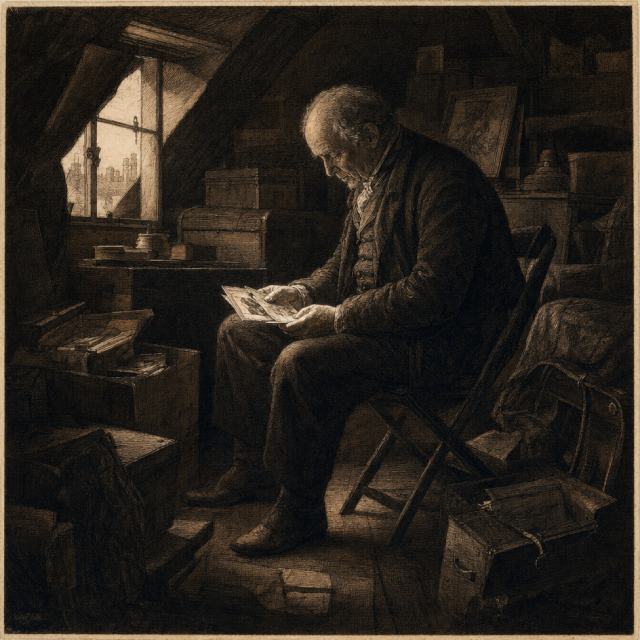
Helmut Bauer was sixty-seven when his daughter brought the boxes.
They were not really his boxes — they were his mother's, her own mother, Ingrid, who had died in March after eighteen months of illness that everyone had seen coming, except, it seemed, Helmut. There were photographs, letters, bank statements, the papers people keep without knowing why and which become, once they are gone, evidence of something.
His daughter's name was Marlene. She was forty years old, had her mother's forehead, and Ingrid's way of putting things down anywhere when she walked into a room — a habit that had driven Helmut mad for thirty-two years of marriage and which, since March, tightened his throat every time he thought of it.
— I don't have the space, he had said.
— Papa, you have an entire attic.
— That attic is full.
— It's full of nothing.
That was true. It was full of nothing — skis he no longer used, mismatched suitcases, a sewing machine Ingrid had bought in 1989 and never opened. Marlene had carried the boxes up on Sunday, set them against the far wall, and come back downstairs without lingering, because she had her own children, her own house, and her own grief to manage.
Helmut had stayed in the attic.
It was a habit he had fallen into without noticing — going up there in the late afternoon, when the light was fading and there was nothing precise left to do. There was a folding chair and a dormer window that looked out over the garden. He would sit. He would look.
At first, he did not open the boxes. He watched them from the corner of his eye the way one watches a neighbour one has not yet greeted, with whom silence has settled in too long to break without effort. Then one evening he opened one, for no particular reason, and found a photograph of their first apartment in Hanover — the two orange sideboards Ingrid had chosen against his wishes, and the stove that smoked whenever you turned it above 180 degrees.
He stayed a long time with that photograph.
What he had said about the sideboards at the time was not kind. What he had said about the stove was not either, nor about other things, in other years, in other apartments. Ingrid had broad shoulders and did not always defend herself, which was itself a way of defending herself that had taken him twenty years to understand. When he had understood, he had changed — not entirely, because no one changes entirely, but enough that Marlene, as a child, then a teenager, then an adult, had two fathers in her memory: the one before, and the one after.
He did not know which father Ingrid had preferred. He had not asked. That was perhaps the heart of the matter.
The boxes also held letters — not his own, letters addressed to her, from a friend who lived in Sweden and with whom Ingrid had kept up a correspondence for forty years. Helmut did not read them. He held them in his hand for a moment, felt the weight of the paper, set them down. There was something indecent about reading what a dead woman had received from another, through eyes that were never meant to see it.
But their weight alone told him something. Ingrid had an inner life he had known poorly. She had correspondents, loyalties, sorrows she had confided to others. This was not a reproach — simply a fact he had not measured while she was still there.
Outside, the garden moved from green to grey. The neighbour was putting away his lawnmower. A child shouted something in the street.
Helmut thought about what he might have done differently. It was a long, familiar list, one he had been keeping since March, and which brought him nothing — neither relief nor understanding, only the feeling of a man turning over a stone to find another stone beneath it. Regret worked that way: it promised a conclusion and delivered none. It occupied the space without furnishing it.
He put the letters down.
Marlene called on Sundays. Their conversations had changed since March — less brief, less practical, more hesitant. She asked him questions she had not asked for twenty years: what he was eating, whether he went out, whether he saw people. He asked after the children with a new attention, as though, now that one generation had disappeared, the others had suddenly acquired value.
He had not always paid attention to Marlene's children. Too small, too loud, too far away — he had his reasons, as one always does. The reasons were not wrong. They were simply not enough.
The following Sunday, when Marlene called, he told her he would like to see the children the weekend after. A silence settled — a silence of surprise, not refusal.
— Both of them? she asked.
— If it's possible.
— They'll be pleased.
He did not know if that was true. Perhaps they would be, perhaps they would not care. They were seven and nine, the age at which a grandfather is mostly someone who smells of an old house and gives out coins. He had no other definition yet to offer them. He could build one.
It was not much. It was not the opposite either.
The attic remained as it was — boxes against the wall, the folding chair, the dormer window. Helmut had not sorted anything, had not thrown anything away. He might go back up. He might reopen the boxes, eventually sort through them, give things away, decide what to do with skis one no longer uses and mismatched suitcases.
Or not. Some things did not need to be resolved in order to stop feeling urgent.
What was clear was that Ingrid had died in March, that the orange sideboards had disappeared thirty years ago into some landfill, and that the only place where he could still choose anything was the following Sunday, with two children he knew poorly and might come to know better.
It was little. It was what he had.



