Persian Letters of the 21st Century.
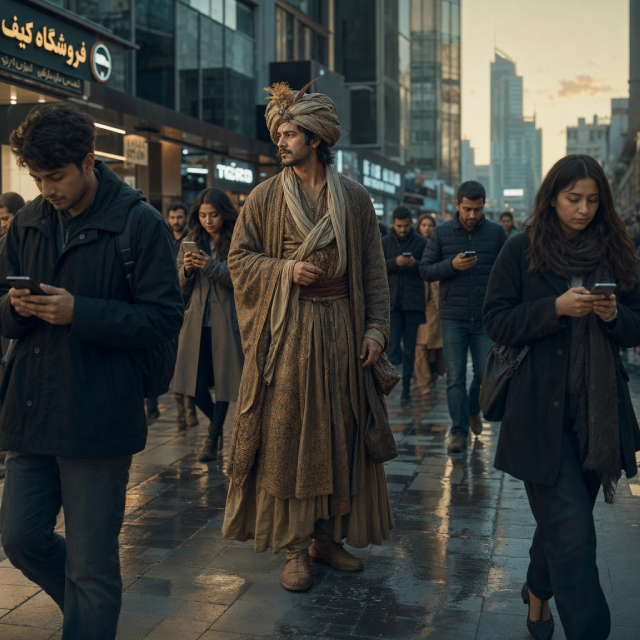
By observing laws, customs, and ways of life, he discovers that nothing is entirely universal: what we believe to be natural often depends on place, history, and habits.
From this arises an essential idea: to preserve liberty, no power should be absolute.
Letter 1. On a country where everyone speaks, but where few truly listen.
My dear friend,
I have arrived in this strange country where men carry in their hands small luminous objects to which they seem to entrust a great part of their lives.
They consult them incessantly. In the streets, in their homes, even between two glances, their eyes come to rest upon them as though searching for something they never quite find.
At first, I believed these were instruments of knowledge. But I soon realized they served above all to speak. Or rather… to respond.
For here, everyone has something to say. And everyone says it immediately. Thoughts are no longer kept, left to ripen. They are shared before they are even understood.
I witnessed strange conversations. Two people, seated face to face, remained silent. Yet each was writing on their luminous object. They were speaking… elsewhere. To others. Always more of them. As though real presence had become insufficient.
What surprised me most, however, was not this abundance of words. It was their fragility. A man asserts something in the morning. He contradicts it by evening. Not because he has reflected. But because someone else spoke louder. Here, truth seems to depend on what circulates the fastest.
I asked myself: How can one still think, when everything calls for a reaction? How can one doubt, when every silence is immediately filled?
And yet, my friend, I do not believe these men are any more shallow than we are. On the contrary, I believe they carry within them the same desire: to understand, to be recognized, not to be wrong alone. But something prevents them from stopping. As though the world were ceaselessly telling them: "Keep going. Respond. Don't wait."
And so I wonder. Perhaps freedom consists not only in being able to speak. But also… in being able to be silent.
I shall continue my observations. For the more I look upon this country, the more familiar it seems to me. And that… troubles me a little.
Your faithful friend, Usbek.

Letter 2. On Invisible Laws.
My dear friend,
I continue to observe this country of which I have spoken to you, and I am beginning to understand that not all of its laws are written. Some are, in fact, nearly invisible.
At first, I believed that laws were contained in great books, carefully drafted, rigorously enforced by those who govern. And it is true that these books exist. But they are not enough to explain what I see. For here, men often obey something else entirely.
One day, I saw a group of people waiting before a closed door. Nothing compelled them to stay. No guard stood watch over them. And yet, not one stepped ahead of the others. They seemed bound by a silent rule.
On another day, I observed a crowd crossing a street. The signal forbade passage. But as several ventured forward regardless, the others followed. And the rule changed… without anything being officially altered.
I then understood this: Laws do not live only in written texts. They live in habits.
This country places great importance on freedom. But this freedom is not the same everywhere. In some places, everyone speaks freely. In others, a single glance is enough to silence. Not through any visible constraint, but because certain opinions seem impossible to express without being immediately rejected.
And so I asked myself: Who truly governs? Is it the one who writes the law? Or the one who determines what it is acceptable to say, to do, to think?
It seems to me, my friend, that power here is more subtle than it ever was among us. It does not always impose itself. It circulates. It slips into glances, into customs, into those rules that no one states… yet everyone observes.
And so perhaps the real question is not: "What are the laws of this country?" But rather: "What is it, here, that makes men obey?"
If this is so, then changing a law is not enough to change a people. One must first understand what, within a people, makes such a law possible.
I continue my observation with fresh attention. For the more I look upon these men, the more I discover that their chains, when they wear them, are rarely visible. And that their very freedom rests upon balances so fragile… that they sometimes seem to forget it altogether.
Your faithful friend, Usbek.



